

Did you just type a sentence and freeze? Is it waring or wearing? You are not alone. Both words sound the same, so the mix-up is easy to make. The good news is that the Waring vs Wearing question has a very short answer.
Wearing is the correct spelling for putting clothes, shoes, or jewelry on your body. It is the “-ing” form of the verb wear. Waring is not a regular English word. It is a last name, as in the Waring blender brand. Use wearing in almost every sentence. This guide explains the meaning, sound, and use of each word with simple examples. You will also see why waring is a common spelling mistake.
Is It Waring or Wearing? The Short Answer
Use wearing. It is the standard spelling in American English. It is also the standard spelling in British English.
Here is the quick rule. If you mean clothes, shoes, glasses, a watch, or a smile on your face, write wearing. If you mean the act of slowly damaging something, write wearing too. Both meanings come from the same verb: wear.
Waring only shows up as a proper name. It might be a person’s last name or a brand. In a normal sentence, it is a spelling error.
So when you wonder about Waring vs Wearing, pick wearing and move on.
What Does Wearing Mean?

Wearing is the present participle of the verb wear. That means it shows an action that is happening now or was happening for a while. It usually follows a form of the verb “to be,” such as is, are, was, or were.
Wearing has a few main meanings:
- Having something on your body: She is wearing a red coat.
- Showing a look or feeling on your face: He was wearing a big smile.
- Slowly damaging something through use: The tires are wearing down.
- Tiring someone out: The long trip is wearing me down.
Wearing can also work as an adjective. For example, “It was a wearing day” means the day was tiring. You will not see this use as often. It sounds a bit formal.
Wearing can also act as a gerund, which is an “-ing” word that works like a noun. For example: “Wearing a helmet keeps you safe.” Here, wearing is the subject of the sentence.
Is Waring a Real Word?
Not in everyday English. You will not find waring in a standard dictionary as a common word. It does not have a meaning of its own in normal writing.
Waring is a proper noun. That means it is a name. Many people have it as a last name. The Waring blender is one famous example. It is named after Fred Waring, an American bandleader who helped promote the early blender.
Because it is a name, you must capitalize it. You write Waring, not waring. If you see a lowercase waring in a regular sentence, it is almost always a typo or a spelling mistake.
There is one more reason people type it. Some writers mean “warring,” as in fighting. We cover that later in this guide.
Waring vs Wearing: Side-by-Side Comparison

A quick table makes the difference clear.
| Term | Correct? | Meaning | Use |
| Wearing | Yes | Having on clothes or items; showing a look; slowly damaging | Everyday and formal writing |
| Waring | Only as a name | A last name or brand name | Names such as the Waring blender |
| Warring | Yes | Fighting or in conflict | “Warring countries,” “warring families” |
| Wear | Yes | Base verb form | “I wear a suit to work.” |
Notice how the table shows that waring has no everyday use. If your sentence does not name a person or brand, change it to wearing.
Read Related Post: Prooving vs Proving: Correct Spelling, Meaning, and Examples
Why Do People Confuse Waring and Wearing?
The answer is sound. Wearing and Waring are pronounced almost the same way. When two words sound alike, your brain picks the spelling that looks easiest.
The word “wear” has an odd spelling. The “ea” does not sound like the “ea” in “bead” or “heat.” It sounds like “air.” Compare it with “bear,” “pear,” and “tear” (the kind that rips). English learners often skip the “e” because it seems silent.
Another reason is typing speed. When you type fast, you may drop the “e” without noticing. Spell check can miss it, because Waring is a real name.
This is a normal slip. Many native speakers make it. The Waring vs Wearing mix-up is really a spelling habit, not a grammar problem.
Wear, Wore, Worn, Wearing: The Verb Forms

Wear is an irregular verb. It does not add “-ed” to make the past tense. Here are all its forms.
| Form | Word | Example |
| Base form | wear | I wear glasses to read. |
| Third person singular | wears | She wears a uniform. |
| Past tense | wore | He wore a blue tie yesterday. |
| Past participle | worn | I have worn this jacket for years. |
| Present participle | wearing | They are wearing hats. |
Use wearing with “am,” “is,” “are,” “was,” or “were.” Use worn with “has,” “have,” or “had.” Use wore by itself for the simple past.
Notice that all of these forms keep the letters “w-e-a-r” or “w-o-r.” None of them is spelled with “a-r” alone. That is a handy clue. The verb never loses its “e” in the “-ing” form.
Where Does the Word Wearing Come From?
The verb wear has old roots. It comes from the Old English verb werian, which meant to clothe, to carry on the body, or to use. Over many centuries, the spelling changed into the form we know today.
The “-ing” ending is a very old English ending. It turns verbs into present participles and gerunds. That is why you see it in running, singing, and wearing.
The name Waring has a different path. It is an English surname. Surnames often come from old personal names or places, and spellings changed a lot over time. The name has no link to the verb wear.
That is why the two words only look alike by accident. One is a verb form. The other is a name.
How Do You Pronounce Wearing and Waring?
Wearing is pronounced WAIR-ing. The first part rhymes with “air” and “care.” The second part sounds like “ing” in “sing.”
Waring, as in the Waring blender, is usually said the same way by most people. This is why you cannot tell the spelling from the sound alone.
Here is an easy trick. Say the word “wear” first. Then add “ing.” If you can hear the verb “wear” inside the word, the spelling is wearing.
Compare this with warring. That word is pronounced WOR-ing. It rhymes with “boring.” The vowel sound is different. So if you mean “fighting,” listen for the “or” sound.
How to Use Wearing in a Sentence
Here are natural examples for different situations.
Everyday conversation
- “I’m wearing my new sneakers today.”
- “Are you wearing a jacket? It’s cold out.”
Workplace communication
- “Everyone on the shop floor is wearing safety glasses.”
- “He was wearing a name badge at the meeting.”
Emails
- “I’ll be wearing a green scarf so you can spot me at the airport.”
- “Please note that staff are wearing masks in the lab.”
Academic writing
- “The study measured how quickly the metal was wearing down under heat.”
- “The researchers noticed the gears were wearing unevenly.”
Business and formal writing
- “Employees are required to be wearing identification at all times.”
- “The company is wearing many hats during the launch.”
Casual writing
- “She was wearing a huge grin after the news.”
The sentence about gears works because wearing describes a slow process. It shows the action is still happening. The sentence about the grin works because a smile can be “worn” like clothing. This is a common figure of speech.
Wearing Thin, Wearing Down, and Wearing Out: Common Phrases
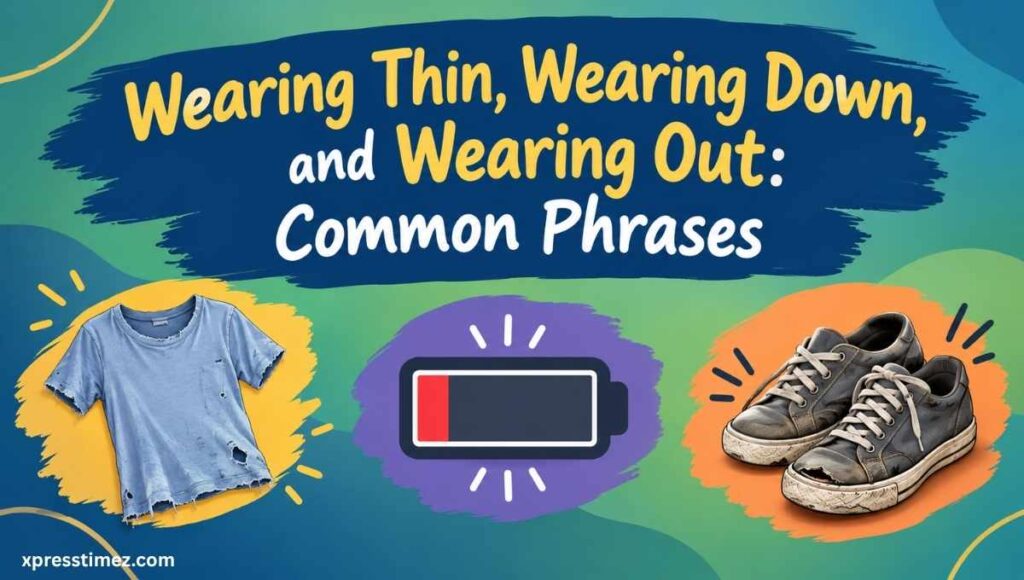
Wearing shows up in many popular phrases. Here is what they mean.
- Wearing thin: becoming less effective or less believable. Example: “His excuses are wearing thin.”
- Wearing down: slowly making something weaker or smaller. Example: “The rain is wearing down the stone steps.”
- Wearing out: becoming too old or damaged to use. Example: “My running shoes are wearing out.”
- Wearing me down: making a person tired or less willing to fight. Example: “The constant noise is wearing me down.”
- Wearing off: slowly fading away. Example: “The medicine is wearing off.”
Each phrase uses the verb wear in its “-ing” form. None uses waring. If you write “My patience is waring thin,” that is a spelling error. The correct sentence is “My patience is wearing thin.”
Common Waring vs Wearing Mistakes
Spelling mistakes are a normal part of learning English. Here are the most common ones, with simple fixes.
Incorrect: She is waring a blue dress.
Correct: She is wearing a blue dress.
The verb needs the “e.” Waring is not the verb form.
Incorrect: The tires keep waring out.
Correct: The tires keep wearing out.
This is a phrase about damage over time. It still uses wear.
Incorrect: He has been wearing that coat since 2019, and it is wore out.
Correct: He has been wearing that coat since 2019, and it is worn out.
Here the mistake is not waring. It is mixing “wore” and “worn.” Use worn after “is,” “has,” or “have.”
Incorrect: The two waring countries signed a peace deal.
Correct: The two warring countries signed a peace deal.
The writer meant “fighting.” That word needs a double “r.”
Incorrect: I bought a waring blender.
Correct: I bought a Waring blender.
Here the name is right, but it needs a capital letter. It is a brand.
Waring vs Warring: Another Easy Mix-Up

Many writers type waring when they actually mean warring. This is a different mistake from the Waring vs Wearing one.
Warring is an adjective. It describes sides that are fighting. You often see it in news and history writing. Examples include “warring tribes,” “warring factions,” and “warring families.”
It comes from the noun “war.” When you add “-ing” to a short word like war, you double the final consonant. That gives you warring.
Here is a simple way to keep them apart:
- Wearing is about clothes and slow damage.
- Warring is about fighting.
- Waring is a name.
If a sentence is about a battle or a conflict, use warring. If it is about clothing or wear and tear, use wearing.
Easy Ways to Remember the Correct Spelling
Here are three simple tricks.
Trick one: find the verb. Take out the “-ing” and see what is left. Wearing becomes wear. Wear is a real verb. Waring becomes war, which has a different meaning. Your sentence about clothes does not make sense with war.
Trick two: think of ear. The word wearing has “ear” in it. You might picture an earring. People often wear earrings. This silly link helps many learners remember the “ea.”
Trick three: check for a name. Ask yourself, “Is this a person or brand?” If yes, waring might be right, and it needs a capital W. If no, use wearing.
Practice helps too. Try reading your own sentences out loud. If you ever pause on Waring vs Wearing again, return to trick one.
Does Wearing Change in American and British English?

No. The spelling is the same in both. American English and British English both use wearing as the “-ing” form of wear.
The verb forms are also the same. Both use wear, wore, worn, and wearing.
There are small differences in how people talk about clothing. For example, a British speaker might say “jumper,” while an American says “sweater.” But the word wearing stays unchanged.
As for tone, wearing works in casual and formal writing. You can use it in a text message or a legal report. Only the idioms change. “Wearing thin” is common in casual talk. “Wearing” as an adjective, as in “a wearing task,” sounds more formal.
Waring vs Wearing Questions Answered
Is it waring or wearing?
It is wearing. Waring is only correct as a name, such as a last name or the Waring blender brand.
What does wearing mean?
Wearing means having something on your body, showing a look on your face, or slowly damaging something. It is the present participle of the verb wear.
How do I use wearing in a sentence?
Pair it with a form of “to be.” For example: “She is wearing a gray sweater to the interview.”
Is waring a spelling mistake?
In a regular sentence, yes. It is usually a typo for wearing. It might also be a typo for warring, which means fighting.
What is the past tense of wear?
The past tense is wore. The past participle is worn. For example: “He wore a suit,” and “He has worn that suit twice.”
How do you pronounce wearing?
Say it as WAIR-ing. The first syllable sounds like “air.” The second sounds like the “ing” in “sing.”
Final Takeaway on Waring vs Wearing
The Waring vs Wearing question comes down to one rule. Use wearing whenever you mean having clothes, shoes, or accessories on your body. It is also the right choice for phrases like wearing thin and wearing me down.
Waring only belongs in names, such as the Waring blender or a person with that last name. If you are not writing a name, you do not need it. Keep the e and the a, and your writing will stay clean and clear. Remember this: if you can swap in the verb wear, the spelling is wearing. That is all there is to it.

Wang Fang is an experienced grammar and language writer who enjoys making English easier to understand. With a passion for clear writing and practical language tips, Wang creates helpful content on grammar, vocabulary, word usage, spelling, and everyday English.
