

Ever typed a word and felt something looked off? It happens to everyone, even careful editors. Stich vs stitch trips up many writers. Here’s the quick answer. Stitch is the correct modern English spelling for sewing, medical stitches, and a side stitch. Stich is a rare historical word for a line of poetry. As a spelling of stitch, it’s a common spelling mistake.
This guide clears up the stich vs stitch confusion in simple steps. Each section uses plain words and real examples, so you can skim. You’ll learn the stitch meaning, the stich meaning, and the difference between stitch and sew. You’ll also see stitch examples, the in stitches meaning, and why Disney’s Stitch has that name. Short drills at the end help the correct spelling of stitch stick.
Stich vs Stitch Quick Answer
Here’s the short answer to stich vs stitch. “Stitch” is the correct modern English spelling. You use it for sewing, medical stitches, and that sharp pain in your side.
“Stich” does exist, but it’s very rare. It means a line of poetry. As a spelling of stitch, it’s a common spelling mistake.
So if you’re writing about thread, wounds, or running, type “stitch.” That’s the whole rule.
What Does “Stitch” Mean?
Let’s start with the real word. The stitch meaning changes with context, but it always comes back to one picture: a needle going in and out.
The stitch definition in plain words is a loop or line of thread that joins things. You’ll see it in sewing and fabric work, in knitting and crochet, and in the hospital.
Stitch as a Noun
As a noun, a stitch is one loop of thread or yarn. You can count it. “She dropped a stitch.” “The hem needs ten more stitches.”
It also names a sharp pain in the side. “I got a stitch halfway through the run.” Same spelling, new meaning. It can also mean a tiny amount, as in “I haven’t done a stitch of work.”
Stitch as a Verb
Stitch as a verb means to join with needle and thread. “She stitched the tear.” “He’s stitching a patch on his jeans.”
You can use it loosely too. Writers stitch together ideas. Editors stitch scenes into a film. The past tense is “stitched,” and the ing form is “stitching.”
What Does Stitch Mean in English?
Stitch meaning in English covers four main ideas: thread work, medical closure, side pain, and a figure of speech. They all grow from the same needle image.
Context tells you which one you mean. Nobody reads “stitches” in an emergency room story as embroidery. That’s why one spelling can serve all of them.
What Does “Stich” Mean?
Now for the odd one. The stich meaning is narrow. In English it’s a line of verse, mostly in Greek or Latin poetry.
You’ll usually meet it inside bigger words. Distich means a two line unit of poetry. Hemistich means half a line. Even acrostic shares the same Greek root.
Is Stich a Real Word?
Yes, but barely. Is stich a word? Dictionaries list it as a rare historical word tied to poetry. Scholars use it. Everyday writers don’t.
German has “Stich” too. It means a stab, a sting, or an engraving. That’s a different language, so don’t carry it into English sentences. The stich definition in English stays poetic.
Is Stich Correct in Modern English?
Is stich correct for sewing? No. When you mean thread, wounds, or side pain, it’s a stich incorrect spelling. Editors will flag it fast.
Old books are the exception. In stich in historical texts, you may spot odd forms because spelling wasn’t fixed back then. Today it is. Stick with stitch.
Read More: Bourgeois vs Bourgeoisie: What’s the Difference? Meaning, Usage & Examples
Stich vs Stitch Key Differences Explained
Here’s where stich vs stitch gets clear. One is a busy, living word with many jobs. The other is a rare historical word with one small job.
Think of it like a dusty antique next to a daily tool. You admire the antique. You use the tool. Choose “stitch” and you’re safe in any essay, blog, or email.
Stich vs Stitch at a Glance
| Feature | Stitch | Stich |
| Status | Correct modern word | Rare, mostly poetic |
| Part of speech | Noun and verb | Noun |
| Meaning | Loop of thread, surgical suture, side pain | A line of verse |
| Used in sewing | Yes | No |
| Pronunciation | Rhymes with “pitch” | Sounds like “stik” |
| Plural | Stitches | Rare, often “stichoi” in scholarly use |
This table covers the whole word comparison in ten seconds. Screenshot it if you like. Your future self will thank you.
Why Do People Confuse Stich and Stitch?
Honestly, it’s easy to do. The word hides a silent trap. That first “t” in “tch” doesn’t get its own sound.
Add fast typing and autocorrect, and mistakes slip through. This kind of spelling confusion happens to every writer. Even careful ones.
Common Spelling and Typing Errors
The usual slip is a missing letter. People type “stich” or “stiches.” The plural stiches vs stitches error is the biggest offender. It shows up everywhere.
Other slips include “stithc” from swapped keys and “stitchs” with the wrong ending. Words ending in “tch” add “es” in the plural. So it’s stitches. Always.
Why “Stich” Looks Correct
Here’s the sneaky part. “Stich” looks right because of phonetic similarity. You say “stitch,” and your brain writes what it hears.
Also, words like “rich” and “which” end in a simple “ch.” Your eyes accept “stich” as normal. But the “tch” pattern follows a rule. A short vowel plus “tch” gives you match, catch, and ditch.
Stitch vs Sew Explained Simply
People mix these up too. They’re cousins, not twins. Stitch vs sew comes down to scope.
“Sew” is the whole job of joining fabric with needle and thread. “Stitch” is the loop or the single motion inside that job.
What Is the Difference Between Stitch and Sew?
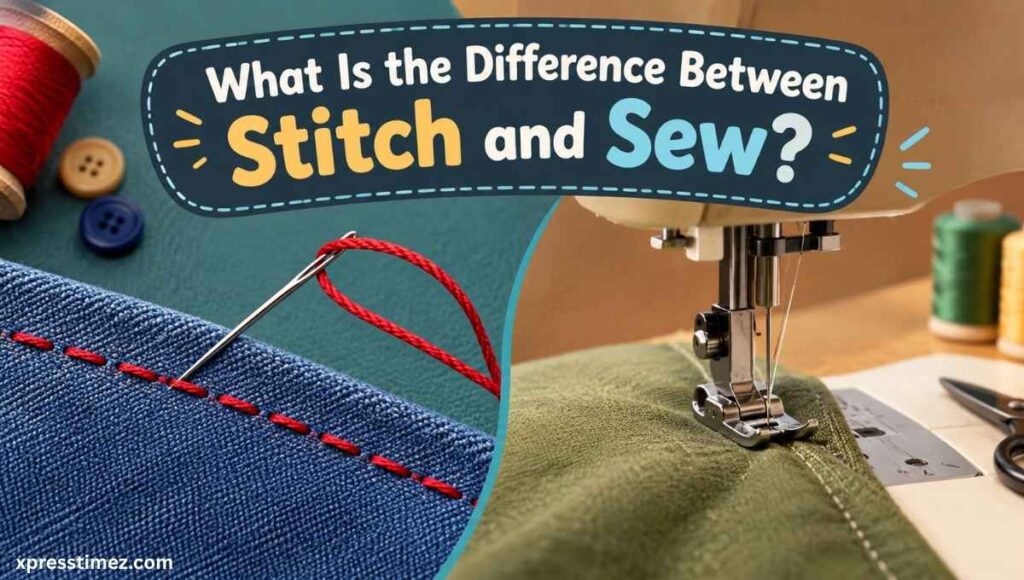
The difference between stitch and sew is big picture versus small detail. You sew a dress. You make stitches while you sew. You can say “stitch a dress,” but “sew” sounds more natural.
Here’s the stitch and sew difference in everyday talk. “I sewed a pillow.” “I stitched the seam, one tiny stitch at a time.” In sewing terminology, “sew” is pronounced “so,” and its past forms are “sewed” and “sewn.”
Common Types and Uses of Stitch
“Stitch” works in four worlds: craft, medicine, sport, and humor. Let’s walk through each one.
Sewing and Knitting Stitches
In craft, a sewing stitch is one pass of the needle. Popular ones include the running stitch, backstitch, and cross stitch. Each does its own job, like basting, strong seams, or decoration.
In knitting stitch work, the knit and purl stitches are the basics. A crochet stitch uses a hook instead. Decorative stitches add flair, like a chain stitch on a denim jacket or stitches in a quilt.
Medical Stitches
Medical stitches are also called medical sutures. Surgical stitches close a surgical incision so skin can knit back together. Wound stitches hold edges tight to close a wound.
Some thread dissolves on its own. Other thread gets removed later. Timing depends on the body area, so follow your doctor’s advice for wound healing. This is general info, not medical advice.
Side Stitch
A side stitch hits during exercise. Many runners know it well. The stitch in the side often appears after eating or drinking before a run. Experts still debate the exact cause.
Slowing down helps. So does deep breathing and pressing a hand on the sore spot. If the pain is severe or comes with other symptoms, see a doctor.
“In Stitches” Meaning
The in stitches meaning is simple. You’re laughing uncontrollably. “Her jokes had us in stitches.” It’s friendly and informal.
This stitches idiom may come from the ache of laughing, a bit like a side stitch. You might also know the proverb “A stitch in time saves nine.” It means fix small problems early.
Examples of Stich and Stitch in Sentences
Examples make rules stick. Here are some clear stitch examples and stitch in a sentence models you can borrow:
- She stitched the fabric along the edge of the cushion.
- Dad needed five stitches after the bike crash.
- I got a stitch in my side during the mile run.
- The comedian had the whole room in stitches.
- Mom taught me a simple running stitch on Sunday.
Now the rare, correct “stich.” “The poet ended the poem with a single stich.” That’s a literary use only. And here’s a wrong one: “I need a stich to fix my sleeve.” Swap it for “stitch.”
Common Mistakes and How to Avoid Them
Most errors come from speed, not ignorance. A quick proofread fixes nearly all of them. So does a tiny bit of memory help.
Remember, correct word usage builds trust. Readers notice small slips, especially in guides about language.
Quick Rules to Remember
- Use stitch for sewing, knitting, medicine, side pain, and laughter.
- Use stich only for a line of verse, and only if you’re a poetry nerd.
- The plural is always stitches.
- After a short vowel, English often uses tch, as in catch and ditch.
How to Spell Stitches Correctly
Here’s a trick for how to spell stitches. Look for “itch” inside the word. Take off “st,” and you get itch. If you can spell itch, you can spell stitch.
Then add “es” for the plural. S, T, I, T, C, H, E, S. That’s the stitches spelling. It’s also your how to remember stitch spelling shortcut.
Practice Exercises
Try these quick drills. Answers are at the end of each set. No peeking.
Basic Sewing and Knitting
- Grandma taught me a new knitting ____.
- Please ____ the button back on my coat.
- The fabric needed three more ____ to hold.
Answers: stitch, sew, stitches.
Medical Context
- The nurse removed the ____ after a week.
- He got six ____ above his eyebrow.
- Fix this: “She needed stiches on her knee.”
Answers: stitches, stitches, stitches.
Idioms and Expressions
- His story had us ____.
- A ____ in time saves nine.
Answers: in stitches, stitch.
Identify and Correct the Error
- “I felt a stich in my side while jogging.”
- “The tailor made tiny stiches.”
Answers: stitch, stitches.
Choose the Correct Word
Pick the right one: (stich / stitch) is the correct spelling for a thread loop. Also pick: the doctor closed the wound with (stiches / stitches).
Answers: stitch, stitches.
Advanced Paragraph Practice
Fix the three errors. “After the race, Maya felt a stich in her side. Later she fell and needed five stiches. Her friends laughed, and soon she was in stitchs.”
Answers: stitch, stitches, stitches.
Spot the Spelling Error
Which one is wrong? Stitching, stitches, stiches, stitched.
Answer: stiches.
Pop Culture Spotlight: Why Is Disney’s Character Called Stitch?
Meet Disney Stitch from Lilo and Stitch. He’s the blue alien known as Experiment 626. Millions of fans know the name, which keeps the correct spelling in front of everyone.
In the film, Lilo gives him the name because of the stitches on his ear. It’s a cute link back to our word. So when someone asks about stich vs stitch in a fan forum, point to the movie poster. It says Stitch.
Stitch Pronunciation and Word Origin
Stitch pronunciation is easy. It rhymes with pitch, witch, and ditch. The “t” stays quiet, so you hear “stich” in your head, which explains the mix up.
The word traces back to Old English “stice,” linked to a prick or stab. That makes sense. A needle pricks fabric over and over. History and spelling line up nicely.
Tips for Writers Using Stitch in Professional Writing
Spellcheck can fail you here. Some tools may treat “stich” as a rare real word and skip it. So proofread by eye, not just by software.
Read your draft out loud. Search the page for “stich” and “stiches” before you publish. In professional writing, a ten second check protects your credibility. Short habit, big payoff.
Key Takeaways: Stich vs Stitch
- Stitch is the correct everyday word for sewing, sutures, and side pain.
- Stich is a rare word for a line of verse.
- The plural is stitches, never “stiches.”
- People confuse the two because of phonetic similarity and a missing “t.”
- Remember the “itch” inside stitch.
- “In stitches” means laughing hard.
FAQs
Is it Stich or Stitch?
It’s stitch. That’s the right spelling for thread, wounds, and side pain. “Stich” belongs only to poetry talk.
What Does “Stich” Mean?
“Stich” means a line of verse. You’ll see it in words like distich. It’s not used for sewing.
What Do Americans Call Stitch?
Americans also say stitch. The word is the same in US and UK English. In a medical setting, people often say “stitches” for sutures.
What Are Two Types of Stitches?
Two simple types are the running stitch and the backstitch. In knitting, the basic pair is knit and purl. In medicine, they’re absorbable and non absorbable sutures.
Why Do People Write Stich Instead of Stitch?
People write the shorter form because they write what they hear. The “t” has no separate sound. Fast typing finishes the job. That’s the heart of the stich vs stitch mix up.
What Is the Difference Between Stitch and Sew?
“Sew” means joining fabric with needle and thread. “Stitch” means the loop or a single pass. You sew a project and make stitches inside it.
Why Did Stitch Get Named Stitch?
In the movie, Lilo names him after the stitches on his ear. The name stuck. Now it’s one of Disney’s best known characters.
Reference: Cambridge Dictionary Definitions
The dictionary definition of stitch in the Cambridge Dictionary covers a short piece of thread sewn through cloth. It also covers a loop of yarn in knitting and a thread used to close a wound. A sudden pain in the side is listed too.
It includes the idiom “in stitches” for laughing hard. For the exact wording, check the Cambridge Dictionary online. I’ve paraphrased it here, and a quick look keeps you accurate.
Conclusion
Let’s wrap up stich vs stitch. “Stitch” is the winner for almost every sentence you’ll write. “Stich” is a tiny poetic word that rarely shows up.
Keep the “itch” trick in your pocket. Check your plurals. And if this guide helped, share it, or tell me which spelling trips you up most in the comments.

Wang Fang is an experienced grammar and language writer who enjoys making English easier to understand. With a passion for clear writing and practical language tips, Wang creates helpful content on grammar, vocabulary, word usage, spelling, and everyday English.
