

Volumn or volume? Here’s the short answer. Volume is the correct spelling. Volumn is a spelling mistake, and no English dictionary lists it as a word.
You’ve probably typed it wrong at least once. Most people have. This guide shows you why it happens, what the word really means, and how to spell it right every time.
Volumn or Volume: Quick Answer
Let’s clear this up fast. When you ask which spelling is correct, the answer never changes. It’s always v-o-l-u-m-e.
There’s no tricky exception here. There’s no regional twist either. One spelling wins, and the other is just a slip.
Is Volume the Correct Spelling?
Yes, it is. Volume is the standard English spelling, and every major volume dictionary lists it this way. You’ll see it in textbooks, news sites, and product manuals.
If you’re wondering how to spell volume, think of it as vol plus ume. The word ends in a silent e, just like “tune” or “cube.”
Is Volumn a Word?
No. People often ask is volumn a word, and the honest answer is no. It doesn’t appear in any trusted dictionary.
So is volumn correct? Never. It’s a volume spelling error that sneaks in when your fingers move faster than your brain.
What Does Volume Mean?

The volume meaning depends on the sentence. This one word wears three hats, and each one is common in daily life.
Once you know them, you’ll spot the right usage quickly. Let’s walk through each one.
Volume as a Measurement
In science, volume tells you how much space something fills. Think of a water bottle, a fish tank, or a shoebox. That’s the volume of an object.
You’ll see volume measurement in liters, gallons, cups, and cubic meters. It’s the volume amount meaning most students learn in math class.
Volume as Sound or Loudness
Here’s the meaning you use every day. The volume of sound is how loud or quiet something is. Your phone’s side button controls it.
That’s why we say volume settings on a TV or speaker. When you shout “turn it down,” you’re talking about the volume sound meaning.
Volume as a Book or Publication
A volume can also be a single book in a set. Picture a big encyclopedia with twenty thick books. Each one is a volume.
Magazines use it too. A journal might say “Volume 12, Issue 3.” That’s the volume book meaning, and it’s a favorite in libraries.
Why Do People Write Volumn Instead of Volume?
So why does volumn keep showing up? Nobody does it on purpose. Usually, the brain is just pattern matching.
Let’s look at the two biggest reasons. Once you see them, the mistake makes total sense.
Confusion With Words Ending in -umn
English has a small group of words that end in “mn.” Think of column, autumn, and hymn. They’re common, so your brain expects that pattern.
That’s the answer to why do people spell volumn this way. The ending “umn” feels familiar, so it slips in by mistake. It’s also why is volumn wrong: the real word ends in “me,” not “mn.”
Read More: 80+ In Summary Synonyms: Similar and Opposite Words You’re Missing
Common Typing and Spelling Errors
Keyboards cause trouble too. The letters M and N sit right next to each other. One quick tap in the wrong order, and you’ve typed volumn.
Fast speech adds to it. When we say the word out loud, the last sound blurs. So it’s easy to guess the wrong ending when writing.
Volumn vs Volume: Key Differences
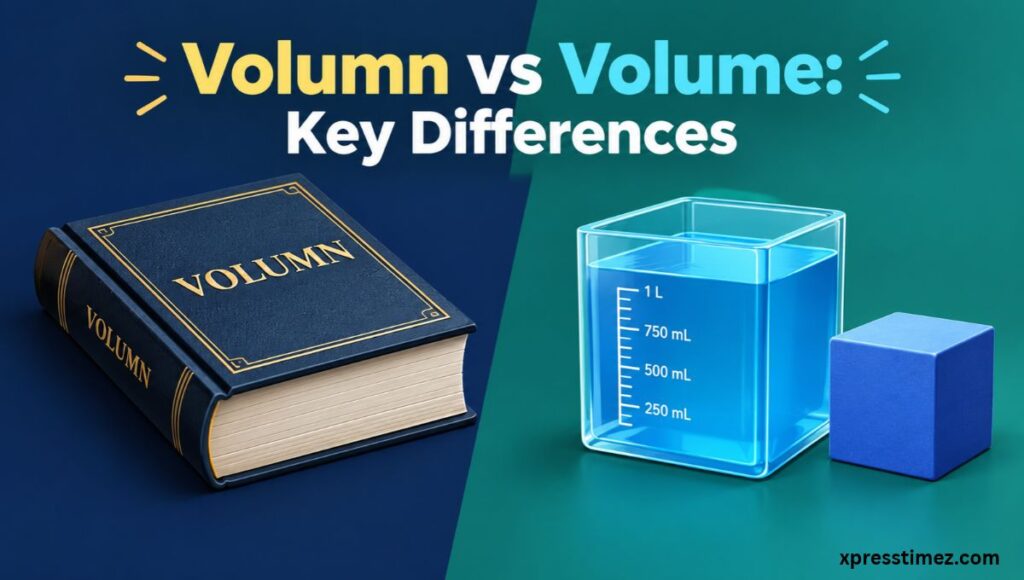
This section works like a quick scorecard. It shows the volume vs volumn difference in plain terms.
There’s only one real winner. Still, seeing the two side by side helps the right spelling stick.
Correct and Incorrect Forms
The correct form of volume is v-o-l-u-m-e. Everything else is a miss. That includes volumn, volumne, volum, and volumen.
Here’s a simple way to remember it. Say the word, then picture the silent e at the end. If it ends in “mn,” it’s wrong.
Meaning and Usage Comparison
Here’s the funny part. Volumn has no meaning at all. It can’t be a noun, a verb, or an adjective.
Volume works as a noun in almost every case. You can say “the volume is high” or “a volume of poems.” Both are perfect.
Is Volume Spelled Differently in British and American English?
Many English words change across the Atlantic. Think of color and colour, or center and centre. So it’s fair to ask if volume does the same.
Good news. This one stays the same everywhere. Let’s see how each variant handles it.
Volume in British English
In British English, the word is spelled volume. There’s no extra letter and no swapped ending. A London newspaper and a Texas blog print it the same way.
So your British English spelling is safe. You won’t need to switch anything when you write for a UK audience.
Volume in American English
In American English, it’s also volume. That’s the standard English spelling you’ll see in U.S. schools, news, and business.
When people search volume in American English, they’re often hoping for a trick. There isn’t one. It’s the same word.
Does Any English Variant Use Volumn?
No variant does. Canadian, Australian, Indian, and South African English all use volume. Volumn doesn’t belong to any of them.
So you can relax about regional rules. Just spell it v-o-l-u-m-e, and you’re covered worldwide.
The Origin and History of the Word Volume

Every word has a backstory. The volume origin is a fun one, and it explains why the word has so many meanings.
It starts with scrolls, not books. Let’s travel back a couple of thousand years.
Latin Origin: Volumen
The word comes from the Latin word volumen. It meant a scroll, a roll of papyrus, or something rolled up. It grew from the Latin verb volvere, which means “to roll.”
Ancient readers didn’t flip pages. They unrolled long sheets. So one roll of writing was one Latin volumen.
How Volume Entered English
The word reached English through Old French around the 1300s. It first meant a book or a roll of writing. Later, it grew to mean size, space, and then loudness.
That’s the origin of the word volume in a nutshell. A rolled scroll took up space, and so the idea of size followed.
Common Spelling Mistakes Related to Volume
Volumn isn’t the only slip people make. There are a few cousins of this error. Knowing them helps you proofread faster.
These are the common volume spelling mistakes you’ll see online. Let’s go through each one.
Volumn
This is the big one. It swaps the final “me” for “mn.” The cause is the pull of words like column and autumn.
It’s a classic volumn misspelling. Spell checkers flag it right away, so it’s easy to fix.
Volumne
Here, the writer adds both an n and an e. It looks like a mix of the real word and the wrong one. It’s a volume spelling mistake that comes from rushed typing.
The fix is simple. Drop the n. Keep the silent e.
Volum
Sometimes the last letter just goes missing. Volum looks short and unfinished. Some people think the e is useless, so they skip it.
But English needs that silent e. Without it, the word reads like a half finished thought.
Volumen
This one is trickier. Volumen is a real word, but not in English. It’s the Latin source word, and it’s also the Spanish word for volume.
So in an English sentence, volumen is wrong. In Spanish text, it’s perfectly fine.
How to Use Volume Correctly in a Sentence
Now let’s put the word to work. Seeing volume in a sentence is the fastest way to lock in the spelling.
Below are examples for different settings. Pick the ones that match your own writing.
Volume in Everyday Writing
In daily life, volume often means loudness. Try these volume sentence examples: “Please lower the volume.” “The volume on my phone is stuck.”
You can also write, “The kids turned up the volume.” These simple lines show the volume word usage most people need.
Volume in Academic and Professional Writing
For volume in academic writing, the word often points to a book or a journal. For example: “The study appeared in Volume 8 of the journal.”
For volume in professional writing, it can mean amount. You might say, “The volume of orders doubled in March.” It’s clear and polished.
Volume in Digital and Social Media
Online, volume pops up everywhere. People talk about the volume of data a server can handle. Gamers adjust the volume in headsets.
On social platforms, you’ll read lines like “Turn up the volume on this song!” Spelling it right keeps your posts looking sharp.
Volume Pronunciation and Abbreviation
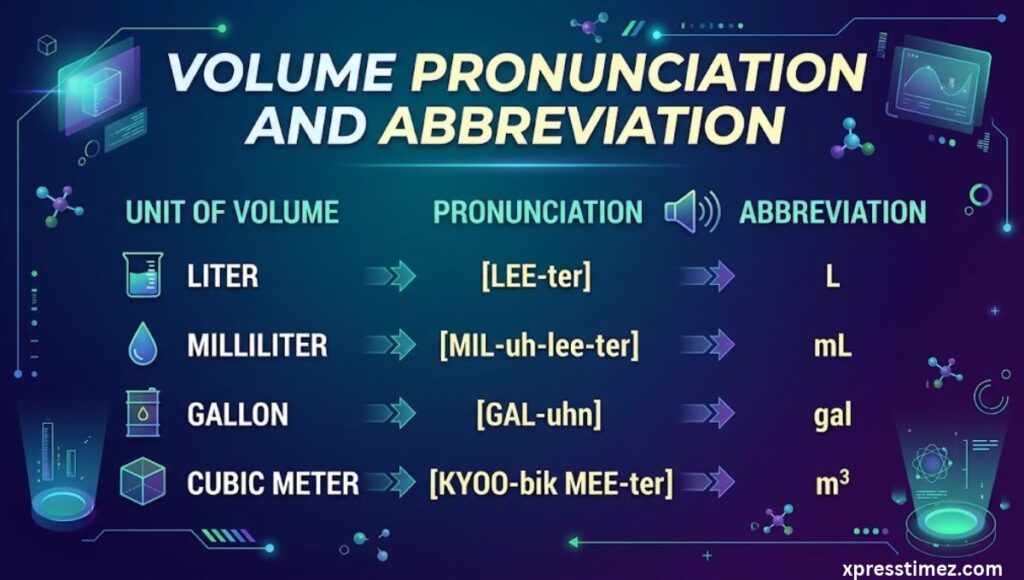
Spelling is only half the story. Many readers also want to know how to say the word and how to shorten it.
Let’s cover sound, shortcuts, and plurals in one place.
How Do You Pronounce Volume?
The volume pronunciation is simple. Say “VOL-yoom.” The stress sits on the first part. In American English, the first vowel sounds like “ah.” In British English, it sounds closer to “o.”
If you’re checking how to pronounce volume, remember there are two syllables, not three. Don’t say “vol-you-me.”
What Is the Abbreviation for Volume?
The abbreviation for volume is usually “vol.” with a period. You’ll see it in citations, like “Vol. 3.” That’s the volume abbreviation for books.
In science, a capital V stands for volume in formulas. Units use short forms like mL, L, and m³.
What Is the Plural of Volume?
The plural of volume is volumes. Just add an s. There’s no odd change, and no extra letters.
You can say “three volumes of poetry” or “high volumes of traffic.” It’s easy, and it works in every case.
Volumn or Volume in Everyday Examples
Real sentences teach better than rules. So here are practical samples for different kinds of writing.
Notice how the right word fits smoothly each time.
Examples in Emails
Emails need quick, clear wording. A line like “Please check the volume on your mic before the call” sounds friendly and correct.
Another one: “We’re seeing a higher volume of requests this week.” Typing volumn here would look careless.
Examples in News
News writers use volume to talk about size and amount. For example: “Trade volume rose sharply on Monday.”
You might also read, “The volume of rainfall broke records.” Reporters get this spelling right because readers trust them.
Examples in Social Media
Posts are short, but spelling still counts. Try: “Crank up the volume, this track is fire.” Or: “Who else keeps the volume at max?”
A typo like volumn can pull attention away from your message. Quick proofreading helps.
Examples in Formal Writing
Formal pieces need exact words. Consider this line: “The second volume of the report covers financial results.”
Or: “The tank has a volume of fifty liters.” Both lines show volume in formal writing done right.
Which Spelling Should You Use?
By now, you know the answer. But different readers have different needs. So here’s how it applies to you.
No matter who you are, the rule stays the same. Use volume.
For Students and English Learners
If you’re learning English, keep it simple. Memorize the word as “vol” plus “ume.” Say it out loud while you write it.
Practice with small sentences. Over time, the correct spelling of volume will feel natural.
For Business and Professional Writing
In work emails and reports, spelling shapes your image. Volume in business writing often means sales, traffic, or orders.
A misspelled word can hurt trust. Run a quick spell check before you hit send.
For Academic and Publishing Use
Editors and professors notice small errors. In essays, always write volume and check citation style for “vol.” rules.
If you’re publishing, a clean manuscript matters. One wrong ending can cost you credibility.
Easy Tricks to Remember How to Spell Volume

Memory tricks beat memorizing rules. These small hacks work well for most people.
Pick the one that clicks for you. Then use it every time.
Here’s one trick. Break the word into three chunks: vol + u + me. Say each chunk as you type.
Here’s another. Remember that “volume” ends the way “resume” and “costume” end. None of them end in “mn.” The “mn” words, like column and autumn, are a separate small group.
Voluminous and Other Words From the Same Family
The word voluminous comes straight from volume. It means large, full, or bulky. A voluminous coat has lots of fabric. A voluminous report has many pages.
Spot the u right before the m? It’s the same pattern. If you can spell voluminous, you can spell volume. The root “volum” stays steady in both.
Other relatives include “volumetric” and “volumetrics.” Scientists use them to talk about measuring space. They all start with the same base.
Frequently Asked Questions
Here are quick answers to the questions people ask most. Each one is short, so you can skim and move on.
Is Volumn Ever Correct?
No. Volumn isn’t correct in any style guide, dictionary, or region. It’s always a volume spelling error.
The only exception is if it’s part of a brand name or a typo in a quote. Even then, it’s not standard English.
Why Do People Spell It Volumn?
Mostly because of look-alike words like column and autumn. Fast typing also plays a part.
It’s a harmless slip. Once you spot it, it’s easy to avoid.
How Do You Spell Volume in English?
It’s V-O-L-U-M-E. Six letters, ending with a silent e. That’s the volume spelling in English, and it never changes.
Say “vol” then “ume.” Write it down once or twice, and it sticks.
What Does Volumen Mean?
Volumen is Latin for a scroll or a roll. It’s also the Spanish word for volume. It’s not used in English.
So if you see it in English text, treat it as a mistake. It belongs to Latin and Spanish.
What Does Speak Volumes Mean?
The idiom speak volumes means something shows a lot without words. For instance, “Her silence spoke volumes.”
The phrase comes from the book meaning of volume. A thick set of books holds loads of information. So the saying stuck.
Can Volume Be Used as an Adjective?
By itself, volume is a noun. But it can act like an adjective in a noun phrase. Think “volume control” or “volume discount.”
In those cases, volume describes the next word. It’s still the same noun doing double duty. The true adjective form is voluminous.
How Do You Pronounce Volume?
Say “VOL-yoom,” with the stress on the first syllable. It has two syllables.
US speakers say the first vowel like “ah.” UK speakers say it like “o.” Both are right.
Conclusion
So, volumn or volume? It’s volume, every time. Volumn is just a common slip caused by words like column and autumn.
Now you know the meanings, the origin, the plural, and the pronunciation. Next time you write about loudness, space, or books, you’ll get it right. Got a spelling question of your own? Drop it in the comments, and share this guide with a friend who keeps typing it wrong.

Wang Fang is an experienced grammar and language writer who enjoys making English easier to understand. With a passion for clear writing and practical language tips, Wang creates helpful content on grammar, vocabulary, word usage, spelling, and everyday English.
