

Many people stop mid-sentence and wonder: is it prooving or proving? You are not alone. Prooving vs Proving is a common spelling question because “prove” has a long “oo” sound. That sound makes people think the word needs two o’s. It does not. Spell checkers catch it, but you should not have to rely on them.
Proving is the correct spelling. Prooving is not a real English word. It is a spelling mistake. The word comes from the verb prove, and you drop the silent e before adding -ing. Once you know this rule, the Prooving vs Proving question is easy to solve. You will also learn how proofing fits in, since that word causes its own mix-ups.
Is It Prooving or Proving? The Quick Answer
Proving is correct. Prooving is a misspelling. “Proving” is the -ing form of the verb “prove.” It means showing that something is true. It works in texts, emails, school papers, and legal writing.
Here is the easiest way to remember it. The verb “prove” has one “o.” So “proving” has one “o” too. The double “o” belongs to a different word, the noun “proof.” That is the whole answer to Prooving vs Proving. The rest of this guide gives the reasons and many examples.
Why Do People Write Prooving?
English spelling plays tricks on everyone. The word “prove” sounds like “proov.” A long “oo” sound is often spelled with two o’s, as in “cool,” “food,” and “proof.” So the brain guesses two o’s.
Another reason is the word “proof.” It looks and sounds close to “prove.” Many writers blend the two. They take the double “o” from proof and drop it into prove.
Fast typing adds to the problem. Your fingers can add an extra letter without you noticing. Spell check usually helps, but not always.
This mix-up is normal. Even skilled writers make it. The Prooving vs Proving confusion just shows how odd English spelling can be.
What Does Proving Mean?
Proving means showing that something is true, real, or correct. It can also mean testing something to see how well it works. Here are the main meanings.
1. Showing that something is true. You use facts, evidence, or logic.
Example: “The test results are proving that the new method works.”
2. Testing the quality of something. You may know the phrase “proving ground.” It is a place where ideas, people, or machines get tested.
Example: “The team is proving the new design in cold weather.”
3. Turning out to be. Here, “prove” means “turn out.” It links the subject to a description.
Example: “The hike is proving harder than we expected.”
Proving can also act like a noun. Grammar books call this a gerund. Example: “Proving a theory takes time.” Here, “proving a theory” is the subject of the sentence.
Read Related Post: Digraph vs Diphthong: What’s the Difference? Meaning and Examples
Prooving vs Proving: Quick Comparison Table
This table shows the key words side by side. Look at the “Correct?” column first.
| Term | Correct? | Meaning | Use |
| Proving | Yes | Showing something is true, or testing it | Everyday, school, work, and legal writing |
| Prooving | No | Nothing. It is a misspelling | Never |
| Prove | Yes | The base verb | Before adding endings like -s or -ing |
| Proof | Yes | A noun meaning evidence | “Do you have proof?” |
| Proofing | Yes | Checking text, letting dough rise, or making something resistant | Editing, baking, and product descriptions |
Only one spelling in the first two rows is real. Proofing is real too, but it is a different word with a different job. You will see how below.
The Silent E Rule: How Prove Becomes Proving

The word “prove” ends in a silent e. You do not hear that e, but it matters. It makes the “o” say its long “oo” sound.
Here is the rule. When a word ends in a silent e, drop the e before an ending that starts with a vowel. The ending -ing starts with the vowel “i.” So the e goes away.
Follow these three steps:
- Start with prove.
- Drop the silent e. You now have prov.
- Add -ing. You get proving.
Notice what did not change. The word still has one “o.” The ending -ing does not add a second one.
Many common verbs follow the same pattern:
- make becomes making
- move becomes moving
- improve becomes improving
- approve becomes approving
- remove becomes removing
A few verbs keep the e. These end in “ee,” “ye,” or “oe,” such as see (seeing) and dye (dyeing). The verb “prove” is not one of them. Apply the rule, and the Prooving vs Proving problem goes away.
Prove, Proved, Proven, and Proving: All the Verb Forms

Prove is a verb with a few forms. Each one has its own job.
- Base form: prove (“I can prove it.”)
- Third person singular: proves (“She proves it every time.”)
- Past tense: proved (“He proved the answer yesterday.”)
- Past participle: proved or proven (“It has been proved.” or “It has been proven.”)
- Present participle: proving (“They are proving the point.”)
The form “proven” causes the most questions. In American English, both “proved” and “proven” are fine after “has” or “have.” Many writers use “proven” before a noun, as in “a proven method.” Use “proved” for the simple past: “She proved me wrong.”
American and British English spell all these forms the same way. You do not need to worry about regional differences here.
How Do You Pronounce Proving?
Say it as PROO-ving. The first part rhymes with “move.” The second part sounds like “ving” in “loving.”
The long “oo” sound comes from the “o” plus the silent e in “prove.” After you drop the e, the sound stays the same. Other words follow this pattern too, like “moving” and “improving.”
A warning: sound alone will not tell you the spelling. The “oo” sound shows up in many spellings, including “food,” “rule,” and “true.” That is why people guess wrong.
Where Does the Word Prove Come From?
English borrowed “prove” from Old French. The French word came from the Latin verb probare. That Latin word meant “to test” or “to show to be good.”
The same Latin root gave English several other words. You can see it in “probe,” “probable,” and “approve.” They all carry the idea of testing or checking.
The word “proof” has a related history. It also came through Old French, from a Latin source linked to testing. Over many years, English settled on “prove” for the verb and “proof” for the noun. These two forms are the ones you use today.
Proving vs Proofing: What Is the Difference?

Prooving vs Proving is a spelling problem. Proving vs proofing is a word choice problem. These are two real words with different meanings.
Proving comes from the verb “prove.” It means showing that something is true.
Proofing has a few meanings:
- Editing: checking a text for errors. Example: “I am proofing the newsletter before it goes out.”
- Baking: letting shaped dough rest and rise before baking.
- Protection: making something resistant to damage, as in waterproofing.
Here is a quick test. Ask yourself, “Am I showing something is true?” If yes, use proving. If you are checking text, working with dough, or making something resistant, use proofing.
Proving Dough vs Proofing Dough in Baking
Baking is the one place where proofing or proving can both be right. Both words describe the rest period when dough rises before it goes in the oven.
In the United States, most bakers say proofing. In British English, many bakers say proving. Both are accepted. The idea behind the word is testing. You wait to see if the yeast is alive and working.
Examples:
- “Let the dough finish proofing for about an hour.”
- “The recipe says to leave the dough proving in a warm spot.”
A small reminder: even in baking, “prooving” is still wrong. The spelling rule does not change.
How to Use Proving in a Sentence
Real writing happens in many settings. These examples show proving in different contexts.
Everyday conversation
“I’m proving to my little brother that I can beat him at chess.”
Idioms
“He isn’t angry. He is just proving a point.”
Workplace
“Our new hire is proving her skills on every project.”
“We are proving the new process with a small test group before the full launch.”
This works because the email describes testing, one of the meanings of proving.
Academic writing
“Researchers spend months proving or disproving a hypothesis.”
Scientists often say “supporting” a hypothesis instead of proving it. Evidence rarely gives absolute proof. This is a good habit in formal science writing.
Legal writing
“The plaintiff has the burden of proving that the contract was broken.”
In law, “proving” often points to who must show the facts.
Innocence and evidence
“In a U.S. criminal trial, the defendant is not responsible for proving innocence. The prosecution must prove guilt.”
This sentence works because it uses “proving” after “responsible for.” Verbs after prepositions need the -ing form.
Ability and theory
“The young pitcher is proving his ability with every game.”
“Proving a theory like this usually takes years of testing.”
Common Spelling Mistakes With Prove and Proof
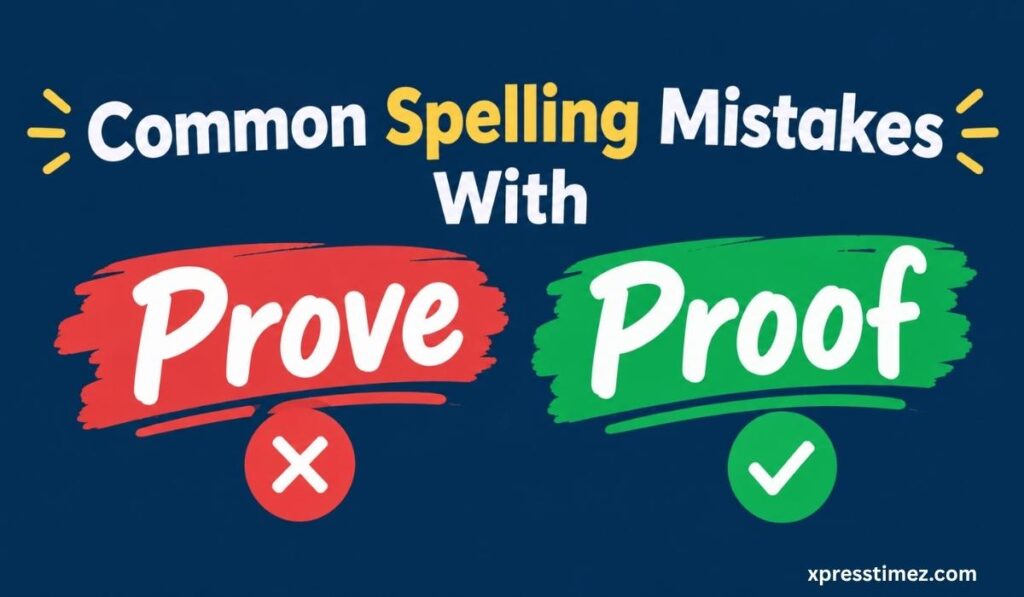
These mistakes are normal. Everyone learns English one error at a time.
Incorrect: She is prooving her point.
Correct: She is proving her point.
This is the heart of Prooving vs Proving. Drop the silent e, and keep one “o.”
Incorrect: I will proove it to you.
Correct: I will prove it to you.
The base verb has one “o,” so adding a second one is not needed.
Incorrect: Do you have any prove?
Correct: Do you have any proof?
“Proof” is the noun. “Prove” is the verb.
Incorrect: I am proofing that I am right.
Correct: I am proving that I am right.
“Proofing” does not mean showing truth. It is for editing, baking, and protection.
Incorrect: Please prove the document before you send it.
Correct: Please proof the document before you send it.
Here the writer wants a text checked for errors. That job belongs to “proof” or “proofread.”
Synonyms for Proving
Sometimes a different word fits better. Here are six useful synonyms and how they differ:
- Demonstrating: showing clearly, often with an example or action.
- Confirming: making sure something is true.
- Verifying: checking that facts are accurate.
- Validating: showing something is sound or acceptable.
- Establishing: proving something firmly, often in formal or legal writing.
- Substantiating: backing up a claim with evidence.
The opposite of proving is disproving. That word follows the same silent e rule: disprove becomes disproving.
Easy Tricks to Remember the Correct Spelling

Use these quick tricks when you feel unsure.
Count the o’s. Prove has one “o.” So proving has one “o.” Prooving has two, so it fails.
Remember the “-ove” family. Move, prove, improve, approve, and remove all share one “o.” Their -ing forms are moving, proving, improving, approving, and removing.
Match the job. “Proof” is the noun, the thing you show. “Prove” is the action. Think of proof as bigger, so it gets two o’s.
Say the base word first. Say “prove,” then ask yourself what happens when you add -ing. The silent e drops out. This habit fixes Prooving vs Proving every time.
FAQs
Is prooving a real word?
No. Prooving is a misspelling. The correct word is proving, the -ing form of prove.
How do you spell proving?
Spell it P-R-O-V-I-N-G. Drop the silent e from “prove,” then add -ing.
What is the present participle of prove?
The present participle is proving. Example: “She is proving her theory.”
Is it proofing or proving in baking?
Both are accepted. Americans usually say proofing. Many British bakers say proving. Both describe the rise before baking.
What is the difference between prove and proof?
“Prove” is a verb meaning to show something is true. “Proof” is a noun meaning evidence. Example: “I can prove it. Here is the proof.”
How do you use proving in a sentence?
Use it when you show or test something. Example: “The new student is proving that hard work pays off.”
Conclusion
The right spelling is proving. Prooving is only a typo. It does not appear in any standard dictionary. Drop the silent e from prove, add -ing, and keep one “o.” That one rule settles the Prooving vs Proving question for good.
Use proofing only when you are checking text, working with dough, or making something resistant. For everything else, such as showing a fact is true, choose proving. Next time you are unsure, say the base word first. Prove has one “o,” so proving has one “o.” Keep that in mind, and you will spell it right every single time.

Wang Fang is an experienced grammar and language writer who enjoys making English easier to understand. With a passion for clear writing and practical language tips, Wang creates helpful content on grammar, vocabulary, word usage, spelling, and everyday English.
