

Do you say “in summary” too much? It can make your writing feel boring. Good news: there are many in summary synonyms you can use instead. Words like “to sum up,” “in short,” and “overall” work just as well. These words help your writing sound fresh and clear. Whether you write essays, emails, or blog posts, changing up your words matters.
In this list, you will find over 80 great options. We cover simple words and formal ones too. You will also see opposite words for when you want to add more, not wrap things up. Let’s explore these useful synonyms together.
What Does “In Summary” Actually Mean?
“In summary” is a transitional phrase used to introduce a brief recap of the main points you’ve already made. It signals to the reader: here comes the short version.
Grammatically, it functions as a prepositional phrase acting as a sentence adverb. It sits at the start of a sentence, is followed by a comma, and does not change the grammar of the sentence that follows it.
The Best Synonyms for “In Summary” (Quick List)
Here’s a fast reference list you can scan before diving into specifics:
- To sum up
- In short
- In brief
- Overall
- All in all
- In essence
- To conclude
- In conclusion
- Briefly
- All things considered
- In a nutshell
- Ultimately
- On the whole
- To summarize
- In closing
Each of these carries a slightly different weight. “In a nutshell” feels casual. “All things considered” feels reflective. “To conclude” feels academic. Choosing the right one is about tone, not just meaning.
Formal Synonyms for In Summary
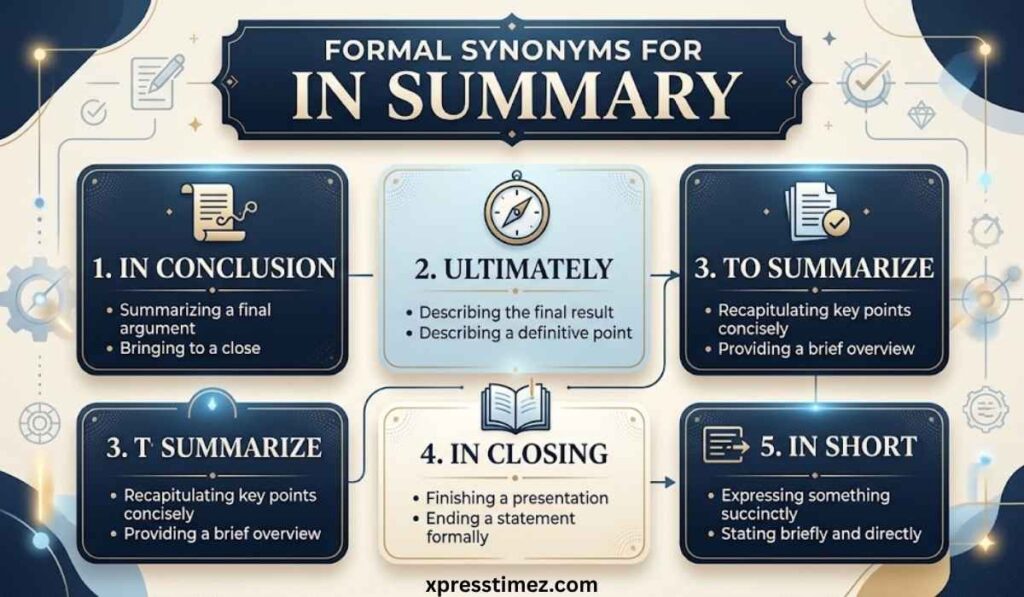
Formal writing, like reports, academic papers, and business documents, calls for phrases that sound polished and precise.
- In conclusion: Signals you’re wrapping up an argument or paper.
- To conclude: Slightly more academic than “in conclusion.”
- On the whole: Useful when summarizing a mixed set of findings.
- In light of the above: Common in legal or business writing.
- Taking everything into account: Good for summarizing multiple factors.
Example: “In light of the above, the committee recommends approving the proposed budget.”
Casual and Conversational Alternatives
For everyday speech, texts, or informal emails, shorter and more relaxed phrases work better.
- Long story short
- Bottom line
- Basically
- In a nutshell
- All in all
Example: “Bottom line, we need more time to finish the project.”
These phrases sound natural in conversation but would feel out of place in a formal report.
Synonyms for Academic and Business Writing
Academic and professional writing often needs synonyms that sound objective and structured.
- To summarize
- In summation
- As a result of the above
- Taken together, these findings suggest
- In brief
Example: “To summarize, the data supports a strong correlation between sleep and productivity.”
“In summation” is technically correct but sounds stiff in modern writing. It shows up more often in legal and courtroom contexts than in everyday business documents.
Transitional Phrases That Work Like In Summary
Some phrases don’t mean exactly the same thing as “in summary” but serve the same transitional purpose of moving from detail into a final point.
- Ultimately
- In the end
- At the end of the day
- When all is said and done
These work best when you’re drawing a conclusion from a discussion rather than restating facts you already listed.
Single Word Synonyms for In Summary
Sometimes you just need one word instead of a whole phrase.
- Overall
- Briefly
- Essentially
- Fundamentally
- Ultimately
Example: “Overall, the product performed better than expected.”
Single word transitions work especially well in shorter paragraphs where a full phrase would feel heavy.
Opposite Words and Contrasting Phrases

Sometimes you need to introduce a shift or exception rather than a summary. These phrases signal contrast instead of conclusion.
- However
- On the other hand
- In contrast
- Despite this
- Nevertheless
These aren’t true opposites of “in summary” in meaning, since “in summary” doesn’t really have a direct antonym. Instead, they serve the opposite function: introducing a contradiction rather than a recap.
Grammar: Is “In Summary” a Sentence Starter or Interrupter?
“In summary” almost always appears at the beginning of a sentence, followed by a comma. It is classified as an introductory phrase.
Correct: “In summary, the results confirm our hypothesis.”
It can occasionally appear mid sentence, set off by commas, though this is far less common:
Correct: “The results, in summary, confirm our hypothesis.”
Both are grammatically valid. The first placement is more natural and more frequently used in professional writing.
Common Mistakes When Using Summary Synonyms
Mistake 1
Incorrect: “In summary the results were positive.”
Correct: “In summary, the results were positive.”
A comma is required after any introductory transitional phrase.
Mistake 2
Incorrect: “To summarize, in conclusion, the project succeeded.”
Correct: “In conclusion, the project succeeded.”
Stacking two summary phrases together is redundant. Pick one.
Mistake 3
Incorrect: “In a nutshell, the committee has determined that fiscal responsibility necessitates budgetary reallocation.”
Correct: “In short, the committee is cutting the budget.”
Casual phrases like “in a nutshell” clash with overly formal sentence structure. Match your tone throughout the sentence, not just at the start.
In Summary vs In Conclusion vs To Sum Up
| Phrase | Formality | Best Used For |
| In summary | Neutral | Recapping main points in reports or essays |
| In conclusion | Formal | Ending an argument, essay, or presentation |
| To sum up | Neutral to casual | Everyday writing and speech |
| In a nutshell | Informal | Conversations and casual writing |
| Overall | Neutral | Short, general wrap up statements |
The differences are subtle but matter. “In conclusion” suggests you’re closing an argument. “In summary” suggests you’re just restating what came before, without necessarily closing anything.
How to Choose the Right Synonym for Your Context
Ask yourself three quick questions before picking a synonym:
- Is this formal or casual writing?
- Am I restating points, or drawing a final judgment?
- Have I already used a similar transition earlier in the document?
If you’re writing a business email, “bottom line” or “in short” usually works well. If you’re finishing an academic paper, “in conclusion” or “to summarize” fits better. Varying your transitions throughout a longer document also keeps your writing from sounding repetitive.
Related Words and Phrases Worth Knowing
- Recap
- Synopsis
- Wrap up
- Rundown
- Digest
- Overview
These aren’t direct substitutes for “in summary” as a transitional phrase, but they’re useful nouns when you’re referring to the summary itself rather than introducing one. For example: “Here’s a quick recap of what we covered.”
Frequently Asked Questions
Is “in summary” grammatically correct?
Yes. “In summary” is a standard, grammatically correct introductory phrase used to signal a brief recap.
What can I say instead of “in summary” in an email?
“Bottom line,” “in short,” or “to sum up” all work well in professional emails without sounding overly formal.
Is “in conclusion” the same as “in summary”?
Not exactly. “In conclusion” signals you’re closing an argument, while “in summary” signals you’re briefly restating points already made.
Can I use “in summary” in academic writing?
Yes, though “to summarize” or “in conclusion” often sound more precise in academic contexts.
Is it wrong to use “in a nutshell” in formal writing?
It’s not grammatically wrong, but it reads as casual. Save it for conversational or informal writing instead.
The Takeaway
There’s no single “correct” synonym for “in summary.” The right choice depends on your tone and purpose: use “in conclusion” or “to summarize” for formal writing, “in short” or “bottom line” for everyday communication, and “overall” when you want something brief and neutral. Once you match the phrase to the context, your writing will feel less repetitive and more natural.

Wang Fang is an experienced grammar and language writer who enjoys making English easier to understand. With a passion for clear writing and practical language tips, Wang creates helpful content on grammar, vocabulary, word usage, spelling, and everyday English.
