

Thiefs or thieves? The correct plural of thief is thieves. Thiefs is a spelling error. It happens when writers add an s out of habit. English follows a different rule here. The f to ves rule turns thief into thieves, just like knife becomes knives.
Many people pause at this plural, and that’s normal. Say it aloud and listen. Irregular plural nouns can trip up anyone. This guide explains why thief changes to thieves. You’ll see clear examples, a simple comparison table, and easy memory tricks. We’ll also cover British English and American English spelling, common mistakes, and the theives typo. By the end, you’ll know exactly which one to use, thiefs or thieves, every single time. Let’s get started.
Thiefs or Thieves: Quick Answer
The correct plural noun is thieves. Thiefs is a spelling error. Thief is the singular, and it turns into thieves when you mean more than one.
If you searched thiefs or thieves because you froze mid-sentence, relax. Many writers pause here. Let’s clear it up fast.
Thiefs
Thiefs is the incorrect spelling. It comes from a common habit of adding an s to make any word plural. That habit works most of the time, but not here.
No major dictionary lists it as a standard plural form of thief. Spell checkers flag it too.
Thieves
Thieves is the right choice in every kind of writing. It works in formal writing, informal writing, and academic writing. It also looks the same in British English and American English.
Say it out loud and you’ll hear the soft /v/ sound at the end. That sound is your clue.
Quick Examples
Here are a few lines to lock it in.
- Two thieves ran from the store.
- The thief left his gloves behind.
- Police caught three thieves on Monday.
What Does Thieves Mean?
Thieves means people who steal. It is the plural form of thief. A thief takes something that belongs to someone else without permission.
The thieves meaning stays the same whether the loss is a wallet or a car. It can also describe sneaky people in a joking way. For example, “The raccoons are little thieves.”
Is Thieves Spelled Correctly?
Yes, thieves is spelled correctly. Every major reference agrees, including Merriam-Webster, the Oxford English Dictionary, the Cambridge Dictionary, and the Collins Dictionary. You won’t find a split vote here.
Watch the order of the letters too. It’s t, h, i, e, v, e, s. Many people flip the i and e, which brings us to theives later.
What Does Thiefs Mean?
Thiefs has no meaning as a regular English word. It’s what happens when a writer applies the add s rule without thinking. The brain wants speed, so it takes the shortcut.
You’ll see it in rushed texts and quick comments. Editors always mark it as a grammar mistake.
Why Does Thief Become Thieves?
English has a long history of changing sounds inside words. Thief ends with an /f/ sound. In the plural, that sound turns into a voiced sound, the /v/ sound.
The old form of the word did this long ago, and the habit stuck. So the plural spelling follows the sound. If you say “thievz,” you spell it with ves.
Read More: Principal vs Principle: Difference and Usage
The F to VES Plural Rule
Here’s the f to ves rule in plain words. Some nouns ending in f or fe drop that ending. Then they take -ves.
Think of thief becoming thieves. Think of knife becoming knives. It’s one of the best-known irregular plural rules in English grammar rules.
Similar Words That Follow the Same Rule
Plenty of everyday words use this pattern. Here are the ones you meet most often.
- leaf leaves
- knife knives
- wolf wolves
- shelf shelves
- half halves
- life lives
- wife wives
- loaf loaves
- calf calves
- elf elves
Notice how every one swaps the -f ending or -fe ending for the -ves ending. Once you see the pattern, thieves feels normal.
Thiefs vs Thieves: Comparison Table
A quick side-by-side helps you decide in seconds.
| Feature | Thiefs | Thieves |
| Correct? | No | Yes |
| Type | Spelling error | Correct plural |
| Ending sound | /f/ | /v/ |
| Used in dictionaries | No | Yes |
| Works in formal writing | No | Yes |
Remember this table the next time you doubt yourself. It shows the thief vs thieves choice clearly.
British English vs American English
Good news for you. British English spelling and American English spelling match here. Both use thieves.
Some words change across the Atlantic, like colour and color. This one doesn’t. You can write for readers anywhere and stay safe.
Example Sentences
Seeing a word in action makes it stick. These sentences show both forms.
- The thief slipped out through the back door.
- Two thieves stole the bike last night.
- Cats can be sneaky thieves when fish is on the table.
- That thief’s mask was in the bag.
- The thieves’ getaway car was blue.
The last two use apostrophes. We’ll cover that soon.
Is Thiefs a Real Word?
No. Thiefs is not a real word in standard English. It only appears as a slip.
You might spot it online, but that doesn’t make it right. Lots of people repeat the same common spelling mistakes, and the mistake spreads.
Can Thief Be Used as a Plural?
No, thief is singular only. You can’t say “three thief” in correct English. You need thieves.
Some writers wonder if the word stays the same, like sheep. It doesn’t. Sheep is a special case, and thief isn’t in that club.
Is Thiefs Ever Correct?
Almost never. In normal writing, you should avoid it. It has no place in school work, news, or business emails.
There is a rare exception. A brand name, a game title, or a joke might use it on purpose. In that case it’s a style choice, not correct English spelling.
Common Mistakes With Thiefs or Thieves
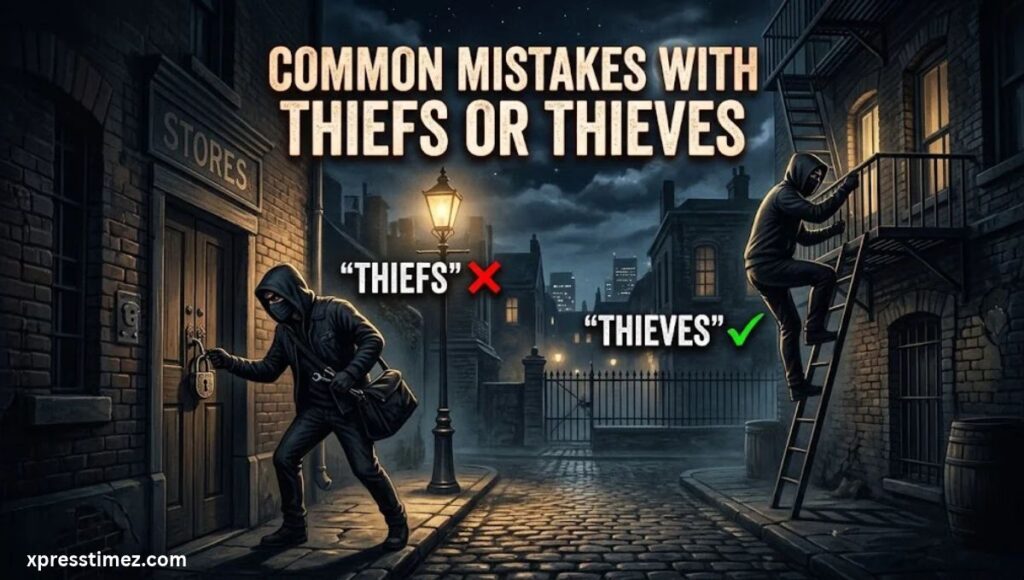
People slip in a few predictable ways. Knowing them helps you catch them early.
Adding S Instead of VES
This is the top mistake. The writer sees thief and adds s like they do with cat or dog. The result is thiefs.
Fix it by asking one question. Does the word end in f? If so, check whether it belongs to the f to ves plural family.
Confusing Thieves With Similar Words
Some writers mix thieves with theives or thives. Others confuse it with the verb thieve, which means to steal. These look close but mean different things or are simply wrong.
Thieve is a verb, as in “They thieve for a living.” Thieves can also be the third person form of that verb, though that use is less common.
Ignoring Irregular Plural Rules
English has many irregular plural nouns. Some change a vowel, like mouse and mice. Others change an ending, like thief and thieves.
If you skip the rules, errors sneak in. A short habit of checking a dictionary fixes most of them.
Other English Words That Change F to VES
Beyond the big list above, a few more words follow the pattern. Scarf can become scarves. Dwarf can become dwarves.
Some words even accept both forms, like hoof (hoofs or hooves). Others stay regular. For example, roof becomes roofs, chief becomes chiefs, and belief becomes beliefs. So not every word ending in f follows the f to ves rule.
Thiefs or Thieves in Everyday Examples
Let’s see how the right form shows up in real life. Each setting has its own tone.
In Emails
In a work email, you might write, “Two thieves broke into the storage room.” Short and clear wins here. A typo like thiefs can make you look rushed.
A quick proofread takes seconds. It protects your professional writing image.
In News
Headlines often say things like “Thieves target local shops.” Reporters follow AP style and standard references. They would never print thiefs.
If you write news posts, copy that habit. Clean spelling builds trust.
On Social Media
Social posts are fast and loose. You’ll still see thieves far more often than the error. When people misspell it, comments often correct them.
Tone is casual there, but accuracy still helps. Your posts look sharper.
In Formal Writing
Academic writing and reports demand care. Use thieves and keep your tone steady. For example, “Historians study how thieves operated in medieval towns.”
Formal readers notice small slips. One bad plural can weaken a strong argument.
Thiefs or Thieves: Usage and Trends
Language shows patterns over time. A look at how people use these words tells us a lot.
Usage Patterns
Thieves appears far more often in books, news, and websites. Thiefs shows up in only a tiny share of searches and mostly as a typo. Search tools often suggest the right spelling for you.
People also search for thief vs thieves when they study grammar. That tells us the confusion is real but easy to cure.
Country Trends
Readers in the US, UK, Canada, and Australia all use thieves. Search interest in the misspelling pops up wherever English learners study. It’s a global question.
Because there’s no regional split, you don’t need separate versions for different audiences. One correct form works everywhere.
How to Remember the Correct Spelling of Thieves
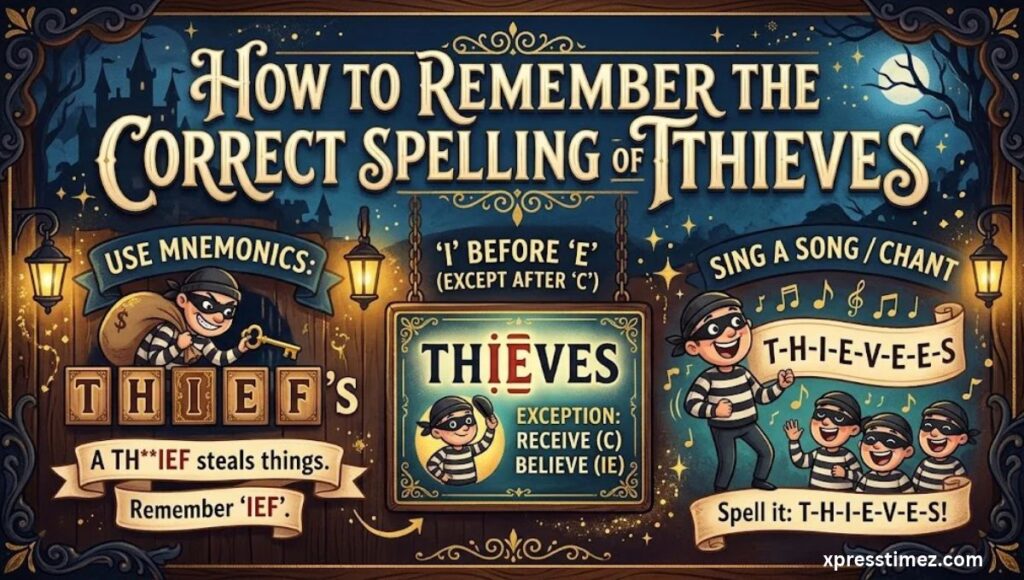
You don’t need fancy tools. A few small tricks do the job.
The VES Family Trick
Think of a family called “The Ves.” Leaf, knife, wolf, and thief all moved in. Say their names and add ves.
When you hesitate, ask which family the word belongs to. That mental picture sticks.
Remember the V Sound
Say the word slowly. You hear “theevz,” not “theefs.” The /v/ sound points to the -ves ending.
Your ears can solve spelling problems. Pronunciation gives you a free hint.
Use the Dictionary Test
When in doubt, look it up. A good dictionary lists the plural form of thief right under the word. It takes ten seconds.
Make it a habit with any tricky word. You’ll build strong English vocabulary over time.
Thief’s vs Thieves vs Thieves’: The Apostrophe Trap
An apostrophe adds a new layer. Thief’s shows possession for one thief, like “the thief’s bag.” Thieves’ shows possession for many, like “the thieves’ hideout.”
Plain thieves has no apostrophe. It simply means more than one. Don’t add one just because it ends in s.
Why Do Writers Mix Up Thieves and Theives?
The second mix-up is theives. It happens because of the old rhyme “i before e, except after c.” The rhyme works for thief, so the i comes first.
Many people swap the vowels by accident. Slow down, and check the order.
Fun Facts About the Word Thief
The word thief goes back to Old English. Its early plural already carried a v sound. So the change you see today is not new.
That makes thieves a good example of English word formation. Words carry history inside their letters.
Frequently Asked Questions
Is It Thiefs or Thieves?
It’s thieves. Thiefs is not correct. Use thieves whenever you mean more than one thief.
Is It Thieves or Theives?
It’s thieves. The i comes before the e. Theives is a common typo.
What Is the Plural of Thief?
The plural of thief is thieves. It follows the f to ves pattern. Dictionaries agree on this.
Why Does Thief Change to Thieves?
The final /f/ sound becomes a /v/ sound in the plural. This is a very old habit in English. Many words share it.
Does British English Spell It Differently?
No. British English and American English both use thieves. There’s no regional difference to worry about.
What Are Other Words Like Thief That Change to VES?
Many words do. Examples include leaf, knife, wolf, shelf, half, life, wife, loaf, calf, and elf. Each one swaps its ending for -ves.
Is Identity Thieves Correct?
Yes. Identity thieves is correct when you mean more than one person. For one person, write “identity thief.”
Conclusion
Thieves is the only correct plural of thief. The mistake thiefs comes from the usual add s habit. English breaks that habit with the f to ves rule.
Use the VES family trick and listen for the /v/ sound. Check a dictionary when you’re unsure. Now you can write thiefs or thieves questions off for good. Share this guide with a friend who loves grammar, and tell us your favorite tricky plural in the comments.

Wang Fang is an experienced grammar and language writer who enjoys making English easier to understand. With a passion for clear writing and practical language tips, Wang creates helpful content on grammar, vocabulary, word usage, spelling, and everyday English.
