

Todays or today’s? Use today’s with an apostrophe almost every time. It shows that something belongs to today, like today’s date, today’s meeting, or today’s weather. It also works as a short form of “today is.” Todays without an apostrophe is a rare plural that most writers never need.
Maybe you’re typing a quick email and your cursor is blinking. You aren’t sure if the apostrophe belongs. That small doubt is common, and it’s easy to fix. In this guide, you’ll learn the simple rule behind today’s. You’ll see clear examples from work, school, and daily life. You’ll also spot the mistakes that trip people up. By the end, you’ll know which spelling to pick and why.
Todays or Today’s: Quick Answer
The quick answer for todays or today’s is simple. Write today’s with an apostrophe before a noun. Write today’s date, today’s weather, and today’s news. That’s the correct use of today’s in nearly every sentence.
Skip the apostrophe only when you mean more than one today. That’s rare. Even then, most writers rephrase.
Here’s a fast test. Ask yourself if something belongs to today or relates to today. If yes, add the apostrophe. You’ll be right about 99 percent of the time.
What Is the Difference Between Today and Today’s?

Today is the plain word. It can work as a noun, an adverb, or a modifier. You say “Today is sunny” or “I’m leaving today.” The word never changes shape.
Today’s is the changed form. It adds an apostrophe and an s. That tiny change gives the word a new job, and it settles the todays or today’s question for most sentences.
Here’s an easy way to see it. Today names the day. Today’s ties something to that day. Compare “Today was long” with “Today’s schedule was long.” The second sentence has a thing that belongs to the day.
The today’s meaning is simple. It means “of today” or “belonging to today.” It can also mean “today is” or “today has.” The todays meaning is much narrower. It points only to the rare plural.
When Should You Use Today’s?
Use today’s when a noun follows. Think of today’s before a noun as a signpost. The signpost says the next word relates to today. You’ll see this in today’s agenda, today’s homework, and today’s headlines.
You’ll also use it as a contraction. In “Today’s my birthday,” the word means “today is.” In “Today’s been busy,” it means “today has.” Your ear usually tells you which one fits.
The One Rule You Need to Know
Here’s the one rule. If a noun follows and it belongs to today, use today’s. That covers a huge share of real sentences. It’s the heart of the today apostrophe rule.
Let’s try a few. “Today’s lesson starts at nine.” “Check today’s deadline before you leave.” “Today’s report is ready.” Each noun belongs to today, so each one gets the apostrophe.
Still unsure? Swap in “of today.” If “the lesson of today” makes sense, use today’s. This trick works every time.
When Is Todays Without an Apostrophe Correct?
Todays is correct in one narrow case. It’s the rare plural form of today. A poet might write about “all our yesterdays and todays.” You’ll find it in literary writing, not in everyday emails.
Most style guides never mention it. Most editors would suggest “days” or “present moments” instead. So is todays correct? Technically yes, but almost never in practice. In the todays or today’s debate, the apostrophe wins.
You may also see todays in brand names, hashtags, and web addresses. Those spellings are choices, not grammar. A company can name itself anything it likes. Your sentences still follow the standard English grammar rules.
Todays Date vs. Today’s Date
Let’s take a common one. Todays date or today’s date? The answer is today’s date. The date belongs to today, so the apostrophe stays.
Think of a form at the doctor’s office. It says “Today’s date:” on the first line. That’s right. It’s also a good model to copy.
Writing todays date is a classic missing apostrophe mistake. It shows up in texts, forms, and even official letters. It’s easy to fix once you spot it.
Read More: Genius vs Genious: Correct Spelling, Meaning, and Usage
Today’s Meeting vs. Todays Meeting

Now picture a Monday morning message. “Today’s meeting moved to 3 p.m.” That’s correct. The meeting belongs to today, so you need the apostrophe.
Here’s the wrong version. “Todays meeting moved to 3 p.m.” It looks almost the same. Readers may not notice, but picky editors will.
Why does this matter at work? Small slips can hurt trust. Your message may be clear, yet one typo can make it look rushed. Get today’s meeting grammar right, and your writing looks careful.
Today’s as a Possessive Form and Contraction
This part trips people up. Today’s can play two roles. It can be a possessive form or a contraction. Both use the same spelling.
As a possessive, it follows the singular possessive pattern. You add ‘s to a singular noun. That’s how possessive nouns like “dog’s bowl” and “teacher’s desk” work. Here, today’s possessive form works the same way: “today’s weather.”
As a contraction, the apostrophe replaces letters. “Today is” becomes today’s. “Today has” becomes today’s too. You can tell them apart by what follows.
A noun after it means possessive. A verb or adjective after it often means contraction. “Today’s forecast” is possessive. “Today’s cold” is a contraction. Same spelling, different job.
Common Mistakes with Todays and Today’s
Most errors in the todays or today’s choice come from rushing. A few repeat again and again. Let’s walk through the big four.
Mistake 1: Dropping the Apostrophe Before a Noun
This is the number one slip. Writers type todays news or todays schedule and move on. The apostrophe is missing, so the word looks like a plural.
Fix it by adding the apostrophe. “Today’s news” and “today’s schedule” are both correct. Read your sentence out loud. If a noun follows, check for the apostrophe.
Mistake 2: Placing the Apostrophe After the S (Todays’)
Some writers flip the order. They write todays’ instead of today’s. That’s the apostrophe after s error. It only fits plural nouns that already end in s.
Today is singular here, so the apostrophe goes before the s. Remember this order: apostrophe first, then s. Think of it like putting on socks before shoes.
Mistake 3: Treating Today Like an Adjective Without an Apostrophe
Look at “today homework” or “today meeting.” They sound close to right, but they’re not. Today isn’t an adjective in standard writing. It needs the possessive tag.
Say “today’s homework” and “today’s meeting.” The today as an adjective idea is common in casual speech. In professional writing grammar, though, it’s a slip.
Mistake 4: Confusing the Adverb and Possessive Forms
Today as an adverb tells you when something happens. “She finishes today.” No apostrophe belongs there. Adding one would be wrong.
Some writers over-correct and write “She finishes today’s.” That sounds odd, and it is. Use today for timing and today’s for belonging. That keeps the two forms apart.
British English vs. American English Spelling
Good news here. Today’s is spelled the same in both places. The British English vs American English split doesn’t touch this word. The todays or today’s rule is the same on both sides of the Atlantic.
Other words do change, like “color” and “colour.” This one doesn’t. It makes life easier for anyone writing for a global audience.
The British English spelling and American English spelling of today’s date are identical. A UK newspaper and a US newspaper both print “today’s headlines.” So you can relax about regional rules.
The Origin of Today’s and Todays
The word today is old. It comes from Old English “to dæge,” which meant “on the day.” Over time, people joined the pieces into one word. Writers once used a hyphen, as in “to-day,” and the hyphen faded later.
The possessive form grew from the same habit that gave us “John’s” and “the dog’s.” English attached ‘s to show belonging. So today’s follows a pattern as old as the language itself. That’s why it feels natural.
The plural todays appears when a writer wants to count days as separate things. It stayed rare because “days” does the job well. That’s also why you almost never see it in plain prose.
Today’s in Everyday Examples
Rules stick better with real sentences. So let’s look at today’s examples from three parts of life. Each one shows the apostrophe at work. Read them aloud and notice how natural they sound.
Work and Professional Examples
At work, today’s agenda sets the tone. “Please review today’s agenda before the call.” “Today’s deadline is noon.” “Send me today’s report by five.”
Notice the pattern. Each noun, like agenda, deadline, and report, belongs to today. Your boss will read these without blinking. A missing apostrophe, though, might raise an eyebrow.
School and Academic Examples
Teachers use this word all day long. “Today’s lesson covers fractions.” “Turn in today’s homework at the door.” “Today’s quiz is short.”
A student can learn the rule quickly. Ask what belongs to today. The lesson does, so it gets the apostrophe. Easy as that.
News and Everyday Conversation Examples
News sites love this word. “Today’s headlines” and “today’s weather” appear on countless homepages. Friends use it too. “What’s today’s plan?” is a normal question.
You can also use the contraction in chat. “Today’s been rough” means “today has been rough.” Both uses are fine. Just keep the apostrophe in place.
Todays or Today’s: Google Trends and Usage Data
People search for todays or today’s often because they aren’t sure. You’ll also see searches like is todays correct and todays date or today’s date. That tells us the confusion is real.
Here’s a useful habit. Open Google Trends and compare “todays” with “today’s.” You’ll see how often people use each form in search. Keep in mind that search spelling and correct spelling are not the same thing.
Why does the no-apostrophe version show up so much? Phones and search bars often skip punctuation. People type fast. So a todays typo can look popular even when the rule hasn’t changed.
Quick Comparison: Today, Today’s, and Todays
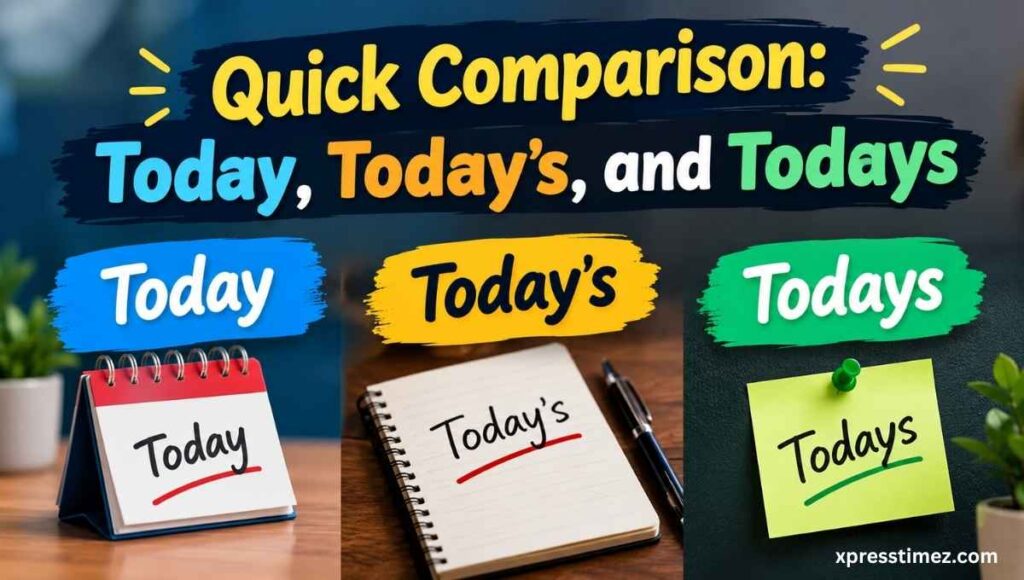
A small table helps here. It shows each form, its job, and an example. Keep it handy when you edit.
| Form | Job | Example |
| Today | Noun or adverb | “Today is Friday.” “I’ll call today.” |
| Today’s | Possessive or contraction | “Today’s date is May 5.” “Today’s cold.” |
| Todays | Rare plural | “All our yesterdays and todays.” |
Look at the middle row. It’s the one you’ll use most. The other two have narrow jobs. If you remember only one thing, remember that row.
Which Spelling Should You Use?
For todays or today’s, choose today’s whenever a noun follows. Choose today when you mean the day itself or its timing. Save todays for the rare plural. This simple order solves most cases.
Want a tiny checklist? Ask three questions. Does something belong to today? Use today’s. Does the sentence say “today is”? Use today’s. Are you counting more than one day? Only then consider todays.
You can also skip the guesswork. If a sentence feels shaky, rewrite it. “The meeting today” works as well as “today’s meeting.” Still, learning the rule is better than dodging it.
Frequently Asked Questions
Is Todays a Real Word?
Yes, but barely. Todays is the plural of the noun today. You’d see it in poetry or old texts. For daily writing, it isn’t the form you want.
Why Does Today’s Need an Apostrophe?
The apostrophe shows possession or a missing letter. It follows the singular possessive pattern, like “dog’s.” It also stands in for letters in “today is.” That’s why today’s needs an apostrophe.
Is It Today’s Date or Todays Date?
It’s today’s date. The date belongs to today. So the apostrophe belongs there too.
Can I Use Todays Without an Apostrophe?
You can in a brand name, hashtag, or web address. You can also use it as a plural in literary writing. In normal sentences, you should use today’s with apostrophe. That keeps your writing clean.
Is Today’s the Same in British and American English?
Yes. Both follow the same rule and the same spelling. You don’t need a separate version for each audience.
What Is the Difference Between Today and Today’s?
Today names the day or tells when. Today’s shows that something relates to or belongs to today. For example, “today” fits “I’m free today,” while “today’s” fits “today’s schedule.”
Is Todays’ Ever Correct?
Almost never. It would mean something belongs to more than one today. Even then, writers choose other wording. For nearly every sentence, today’s is the right choice.
Can Today’s Mean Today Is?
Yes. In “Today’s Friday,” the word is short for “today is.” It can also mean “today has.” Context tells you which one it is.
Conclusion
When it comes to todays or today’s, pick today’s nearly every time. It shows that something belongs to today, like today’s weather or today’s meeting. It also works as a contraction for “today is.” Remember the apostrophe goes before the s, not after.
Todays has a tiny role as a rare plural. Everyday writing almost never calls for it. Next time you’re stuck, ask what belongs to today. Got a tricky sentence you want checked? Drop it in the comments or share this guide with a friend who keeps tripping on the apostrophe.

Wang Fang is an experienced grammar and language writer who enjoys making English easier to understand. With a passion for clear writing and practical language tips, Wang creates helpful content on grammar, vocabulary, word usage, spelling, and everyday English.
