

Holiday is the correct spelling. It has one “L” and one “D” in the middle. Holliday is not a word in English. It only works as a surname, like Doc Holliday.
You’ve probably paused mid-sentence and wondered, “is Holliday a word?” You’re not alone. Many writers type holliday vs holiday into Google every day. This guide clears it up fast. You’ll also get memory tricks, examples, and a short quiz.
Holliday vs Holiday: The Correct Answer
The correct spelling of holiday is h-o-l-i-d-a-y. Count the letters: one L, one I, one D. That’s it. If you write Holliday for a day off, it’s a holliday spelling mistake.
Think of it like this. A holiday is a common word. It needs no extra letters. Keep it light, just like the day itself.
Quick Reference Table
| Spelling | Correct? | When to Use It |
| Holiday | Yes | A day off, a trip, a celebration |
| Holliday | Only as a name | Surname Holliday, like Doc Holliday |
| Hollidays | No | Never use it for the plural |
| Holidays | Yes | The plural, as in Happy Holidays |
Save this table. It answers which spelling is correct, holiday or holliday, in about five seconds.
Holiday Meaning and Definition
The holiday meaning depends on where you live. It can mean a special day or a break from work. In British English, it also means a trip.
Let’s break it down. Then you’ll know exactly how to use it.
Holiday Meaning
A holiday is a day when people rest or celebrate. Schools close. Offices shut down. Families get together.
It can also mean time away from your normal routine. You might say, “I’m taking a holiday in July.”
Holiday Definition
The holiday definition in English has two parts. First, it’s a day set aside for a special reason. Second, it’s a period of rest from work or school.
So a holiday can be one day or two weeks. Both count.
Is “Holliday” a Valid English Word?
No, Holliday isn’t a valid English word. You won’t find it in standard dictionaries as a common noun. It shows up only as a proper noun.
So if you see it in a sentence about a day off, it’s a typo.
Accurate Explanation
Is Holliday a proper noun? Yes. It’s a family name and sometimes a place name. Hollidaysburg in Pennsylvania is one example.
As a common noun, only holiday works. Proper nouns get capital letters. Common nouns don’t, unless they start a sentence.
What Is the Meaning of Holliday?
People ask, what is the meaning of Holliday? On its own, it has no dictionary meaning. It’s just a surname.
The name likely comes from an older form of “holy day.” Families took it as a last name long ago.
Example of Correct Usage
Here’s a correct use: “John Henry Holliday was a gambler and dentist.” That’s a name, so the double L is right.
Now compare: “We have a holiday on Monday.” Here you need the one-L version.
Holliday vs Holiday: Key Differences
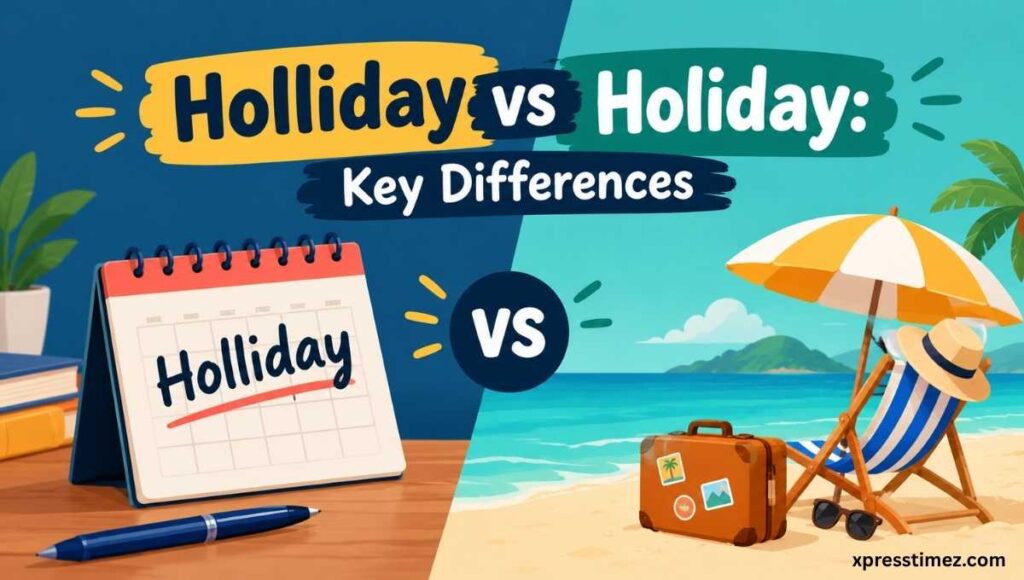
The key difference is simple. Holiday is a common word. Holliday is a name. One describes a day off. The other describes a person.
Here’s a handy way to see it. Ask yourself, “Is this a person’s name?” If yes, check the spelling of that name. If no, use holiday.
Also, holiday vs holliday meaning isn’t a fair match. Holiday has meaning. Holliday only points to a family or a person.
How to Spell Holiday Correctly
Say it slowly: hol-i-day. Three beats, three parts. Write them down in order. Nothing doubles.
That’s the whole trick for how to spell holiday correctly. Break it into chunks and you won’t miss.
Common Errors
The most common holiday spelling mistakes are:
- Holliday (extra L)
- Hollyday (mixing in “holly”)
- Holyday (an old spelling)
- Holidey (wrong ending)
These show up in emails, school papers, and social media posts. They’re easy to fix once you spot them.
Causes of Errors
Why do people spell holiday incorrectly? Mostly because of sound. We say “HOL-ih-day,” and the first vowel sounds short. Some writers double the L to show that.
Another cause is famous names. Doc Holliday, anyone? Your brain sees the double L and borrows it.
Read More: Bourgeois vs Bourgeoisie: What’s the Difference? Meaning, Usage & Examples
The Origin of the Word “Holiday”
The origin of the word holiday is pretty cool. It started as two words. They stuck together over time.
Knowing this helps you remember the spelling. It also explains why the word has just one L.
Etymology
The holiday etymology goes back to Old English. The word was hāligdæg. It joined hālig (holy) and dæg (day).
So a holiday began as a holy day. Religious feasts were the first days off.
Historical Development
Over centuries, the sound changed. “Holy” got shorter. “Day” stayed. By the 1500s, people wrote it as one word, much like we do now.
Later, the meaning widened. It stopped being only about religion. Today it covers all kinds of days off.
Types of Holidays
Not all holidays are the same. Some close banks. Some just bring cake. Let’s sort them out.
Knowing the types also helps you use the word correctly in your writing.
Common Categories
- Public holiday: Set by the government. Offices often close.
- National holiday: Celebrates a country’s history, like Independence Day.
- Religious holiday: Tied to faith, like Christmas, Eid, or Diwali.
- School holiday: A break from classes, like spring break.
- Paid holiday leave: Time off that your employer pays for.
Each of these keeps the same spelling. One L, always.
British vs American English Usage
Here’s the good news. The spelling doesn’t change between the UK and US. Holiday is the same on both sides of the Atlantic. So the holiday spelling in American English and the holiday spelling in British English match.
What changes is how people use the word. That’s where things get fun.
Key Fact
Is holiday spelled differently in the UK and US? No. It’s spelled identically. Only the meaning leans different ways.
So you won’t need to switch spellings like you do with “color” and “colour.” One less thing to worry about.
Usage Distinction
In British English holiday often means a trip. A Brit says, “We’re going on holiday to Spain.” An American says, “We’re going on vacation.”
In American English holiday usually means a specific day, like Thanksgiving. Americans also say “the holidays” for the winter season.
Why the Confusion Exists
The confusion has a few sources. Sound is the first. Names are the second. Autocorrect is the third.
Let’s look at each one. Once you see the pattern, the mistake loses its power.
People hear the short “o” and want to double the consonant. English often does that, as in “rabbit” or “summer.” So the double L feels natural, even though it’s wrong here.
Also, Doc Holliday is famous. Movies, books, and TV shows keep his name in front of us. We see the double L a lot.
Holiday vs Vacation: Clarifying the Difference

People mix these words all the time. Both mean time away. Yet they aren’t always interchangeable.
The difference comes down to place and context. Let’s sort it out.
Key Insight
The holiday vs vacation question is mostly about region. In the UK, holiday means a trip. In the US, vacation means a trip.
For holiday vs vacation in American English, a holiday is a special day. For holiday vs vacation in British English, they’re closer in meaning. That’s the difference between a holiday and a vacation in plain terms.
Holiday in Everyday Usage
We use this word constantly. It shows up in talk, texts, and cards. Let’s look at how.
Seeing it in context helps lock in the spelling. Repetition works like a gym for your memory.
Common Expressions
- Happy holidays (a warm greeting in winter)
- Holiday season (late November through early January)
- Bank holiday (common in the UK)
- Holiday mood (feeling relaxed and festive)
- Busman’s holiday (spending time off doing your job)
Notice that happy holidays spelling has one L in each “holiday.” Happy Hollidays is wrong.
Examples of Holiday in Sentences
Here are some holiday examples in sentences:
- “The holiday season starts right after Thanksgiving.”
- “She took a week of paid holiday leave.”
- “Is Monday a public holiday?”
- “We spent our school holiday at the beach.”
That’s how to use holiday in a sentence. Short and simple.
Common Mistakes with Holliday vs Holiday

Mistakes happen to everyone. Even good writers slip. Let’s look at the usual ones.
Spotting them is half the fix. The other half is practice.
Frequent Mistakes
The top error is using Holliday as a common noun. Another is writing Hollidays in greeting cards. A third is mixing in holyday, the old form.
You’ll see these in school essays, social posts, and even company emails. They’re easy to miss when you read fast.
Examples of Incorrect and Correct Spelling
| Incorrect | Correct |
| Have a great Holliday! | Have a great holiday! |
| Happy Hollidays, everyone! | Happy Holidays, everyone! |
| Our holyday plans are set. | Our holiday plans are set. |
| The Holiday gang rode into town. | The Holliday gang rode into town. (name) |
The last row flips the rule. When it’s the person’s name, the double L is right.
When “Holliday” Is Correct
So when can you use the double L? Only when you mean a name or a place. That’s the whole rule.
It’s a small window, but it matters. Use it right and you’ll look sharp.
Appropriate Contexts
Use Holliday for people with that last name. Use it for places named after them. Use it in titles about historical figures.
Think of Holliday as a surname and holiday as a common noun. Two jobs, two spellings.
Example
“Doc Holliday was a famous figure of the Old West.” That’s correct. It’s his name.
Also note that singer Billie Holiday spelled her name with one L. So always check how a person spells their own name.
Holiday Spelling Rules and Memory Tips (Added)
Rules help, but tricks help more. Here are a few that work. Pick the one that sticks.
Your brain likes pictures and silly phrases. Use that.
How to Remember the Correct Spelling
Try this: “A holiday is a holy day.” Holy has one L. So holiday has one L.
Another trick: “Holiday has one L, just like light luggage.” Keep it light. Don’t overload the word.
Why Holiday Has One “L”
The word grew from “holy” plus “day.” Holy has one L, so the L never doubled. English simply kept the original letters.
This is the heart of holiday grammar rules for spelling. Trace the root and the answer shows up.
Will Spellcheck Identify the Error?
Sometimes yes, sometimes no. It depends on the tool. Don’t trust it blindly.
Let’s see why.
Reason
Holliday is a real name, so many tools don’t flag it. The software thinks you meant a person. It sees a valid proper noun and moves on.
That’s why a holliday spelling mistake can sneak through a final draft.
Recommendation
Proofread by eye. Search your document for “holliday” before you hit send. Read it out loud, too.
For important work, ask a friend to read it. Fresh eyes catch what tired eyes miss.
Case Study: Professional Communication Impact

Imagine a small shop owner. She sends a newsletter titled “Our Holliday Sale Starts Friday!” Customers notice. A few reply with jokes.
Nobody cancels an order over it. But trust takes a tiny hit. It looks careless.
Evaluation
Small errors in big headlines hurt credibility. Readers assume the details matter less to you. That’s unfair, but it’s real.
Fixing it is free. One quick check protects your brand every time.
Quick Rule to Remember
Here’s the rule in one line: Day off = holiday. Person’s name = Holliday.
That’s it. Put it on a sticky note if you need to.
Common Patterns You Should Notice
Look at words like “holy,” “holiday,” and “holyday.” They share a root. Nothing in that family doubles the L.
Also notice other compound words from old English. They often keep each part’s spelling. That’s a helpful habit for spotting patterns.
Practice Exercises
Time to test yourself. Don’t worry. It’s short and friendly.
Try the questions before peeking at answers.
Fill in the Blanks (With Detailed Explanations)
Pick the right spelling for each blank.
Questions
- We’re taking a long ____ in August.
- ____ was a dentist in the Old West. (the famous gunfighter)
- Wishing you a happy ____ season!
Answers and Explanations
- Holiday. It’s a common noun meaning a break.
- Doc Holliday. It’s a person’s name, so the double L is right.
- Holiday. It describes the holiday season, a common phrase.
Multiple Choice (With Reasoning)
Choose the correct option.
Questions
- Which is the correct spelling of the common word?
a) Holliday b) Holiday c) Hollyday - Which sentence is correct?
a) Happy Hollidays! b) Happy Holidays!
Answers and Explanations
- b) Holiday. It has one L, tied to “holy day.”
- b) Happy Holidays! The plural just adds an “s.” No extra letters.
Trick Question (To Test Real Understanding)
Is this sentence correct? “Mr. Holliday asked for a holiday.”
Explanation
Yes, it is. Holliday is a name here. Holiday is the common noun. Both spellings appear, and both are right.
That’s the real test. It shows you understand the rule, not just the answer.
Mini Challenge (Boost Your Confidence)
Fix these sentences: “Our Holliday party is Friday.” “The Holyday was fun.”
Corrected Versions
“Our holiday party is Friday.” “The holiday was fun.”
Nice work if you got both. You’re ready.
Holiday vs Holliday: Examples in Different Contexts (Added)
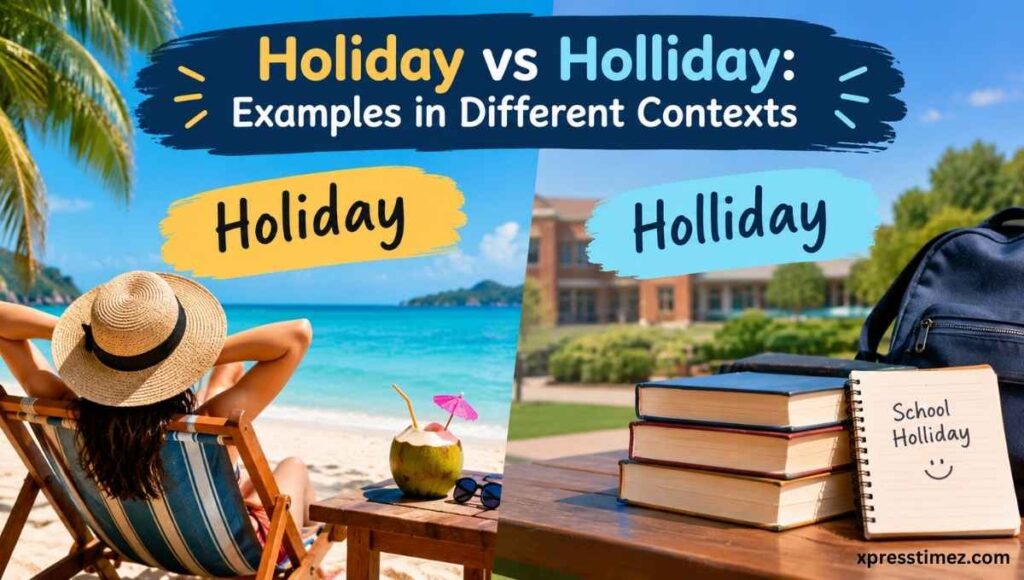
Let’s wrap the rule with more examples. Seeing both spellings in real use helps most.
Read each one out loud. Notice how the name and the word play different roles.
Holiday in Travel and Vacation Sentences
- “We booked a holiday to Italy.”
- “Her holiday photos were stunning.”
- “I’m saving up for a summer holiday.”
Holliday as a Person’s Surname
- “Doc Holliday played cards in Tombstone.”
- “The Holliday family moved to Georgia.”
- “Ms. Holliday will lead the meeting.”
Final Tip
When in doubt, ask one question: “Is this a name?” If not, drop the extra L. Simple, quick, and reliable.
Pair that with a quick proofread. You’ll avoid the holliday spelling mistake almost every time.
Key Takeaways
- Holiday is the correct spelling for a day off or a trip.
- Holliday is only a surname or place name.
- The spelling is the same in American English holiday and British English holiday.
- Remember: holiday comes from “holy day,” so it has one L.
- Holiday vs vacation depends on region and context.
- Spellcheck may miss Holliday because it’s a valid name.
FAQs
Is It Holliday or Holiday?
It’s holiday for the common word. Use Holliday only when you mean a person’s name or a place.
What Is the Meaning of Holliday?
Holliday has no common dictionary meaning. It’s a family name, best known from Doc Holliday.
How Do Americans Spell Holiday?
Americans spell it holiday, with one L. The spelling matches British English exactly.
Is Holiday Correct Grammar?
Yes. Holiday is a correct noun. It can also work as an adjective, as in “holiday season.” It can even be a verb in British English, like “They holiday in Spain.”
Is “Holliday” Ever Acceptable?
Yes, but only as a proper noun. It’s fine for names like Doc Holliday or the town of Hollidaysburg.
Final Thoughts
You now know the answer to holliday vs holiday. One L for the day off. Two L’s for the name. That’s all it takes.
Next time you write “holiday,” take a second to check. It’s quick and keeps your writing clean. Got a spelling mix up you’d like cleared next? Share it in the comments and keep the conversation going.

Wang Fang is an experienced grammar and language writer who enjoys making English easier to understand. With a passion for clear writing and practical language tips, Wang creates helpful content on grammar, vocabulary, word usage, spelling, and everyday English.
