

The latter two means the final two items in a list of three or more. It sets them apart from the first item. The last two simply means the final two by position. If you’re unsure, pick the last two. It’s safer and sounds more natural.
Have you ever frozen mid-sentence and wondered which one fits? You’re not alone. This guide on The Latter Two vs The Last Two explains the latter two meaning, shows real examples, and helps you choose with confidence.
What Is the Short Answer?
Think of it this way. The latter two is about contrast. The last two is about order or sequence. One compares, and the other counts from the end.
Most writers do fine with “the last two.” It works for steps, dates, chapters, and final two candidates. The latter two works in fewer cases, and we’ll cover them below. That’s the heart of The Latter Two vs The Last Two.
What Does “The Latter Two” Mean?
The phrase grows out of former and latter. Those words normally point to two named items. “The latter two” stretches that idea to a longer list.
Some writers like it. Others find it clumsy. Let’s see how it works.
Definition of “The Latter Two”
The latter two refers to the final pair in a previously mentioned group, usually a list of three. It separates that pair from the first item.
The latter definition here isn’t about time. It’s about where items sit in your sentence. That’s why some readers pause.
Example of “The Latter Two”
Try this: “We tested a desktop, a laptop, and a tablet. The latter two had better battery life.” The laptop and tablet are the latter two. The desktop stands alone.
See the contrast? The desktop plugs into a wall. The other two don’t. That difference makes the phrase work.
What Does “The Last Two” Mean?
Last two meaning is simple. It’s the final two things, in any order, with no contrast needed.
You can use it with a list of any size. You can use it with time, too.
Definition of “The Last Two”
The last two points to the end of a sequence. It matches the final two and the final pair in everyday use.
It also works for the end of a period, like the last two years. Nothing fancy is going on.
Example of “The Last Two”
Here’s one: “Read the last two chapters before class.” You don’t need to name any other chapter. The position tells the whole story.
Another: “She won the last two races.” Clear, short, and natural.
Read More: Dis and Mis Prefixes: Meaning, Differences, and Examples
The Latter Two vs the Last Two: Key Differences
These phrases do different jobs. One highlights contrast, and the other highlights position. Knowing that saves you from most mistakes.
The latter two vs last two question really comes down to what you want the reader to notice. In short, The Latter Two vs The Last Two is a choice about focus.
Latter Two Highlights Contrast
“The latter two” works when the first item differs from the rest. Your reader needs to see a two-versus-one split.
Without that split, the phrase feels forced. A plain “last two” would do better.
Last Two Highlights Position
“The last two” cares only about list order. It answers one question: what comes at the end?
Because it needs no contrast, it fits almost any sentence. That’s a big reason it wins in everyday English.
Quick Comparison Table
| Feature | The Latter Two | The Last Two |
| Main job | Shows contrast | Shows position |
| Best list size | Exactly three items | Any size |
| Needs items named first? | Yes | No |
| Tone | Formal | Neutral |
| Risk of confusion | Higher | Low |
Use this table as a quick answer on The Latter Two vs The Last Two when you’re editing in a hurry.s different. One says “second half.” The other says “final items.”
Is “The Latter Two” Grammatically Correct?
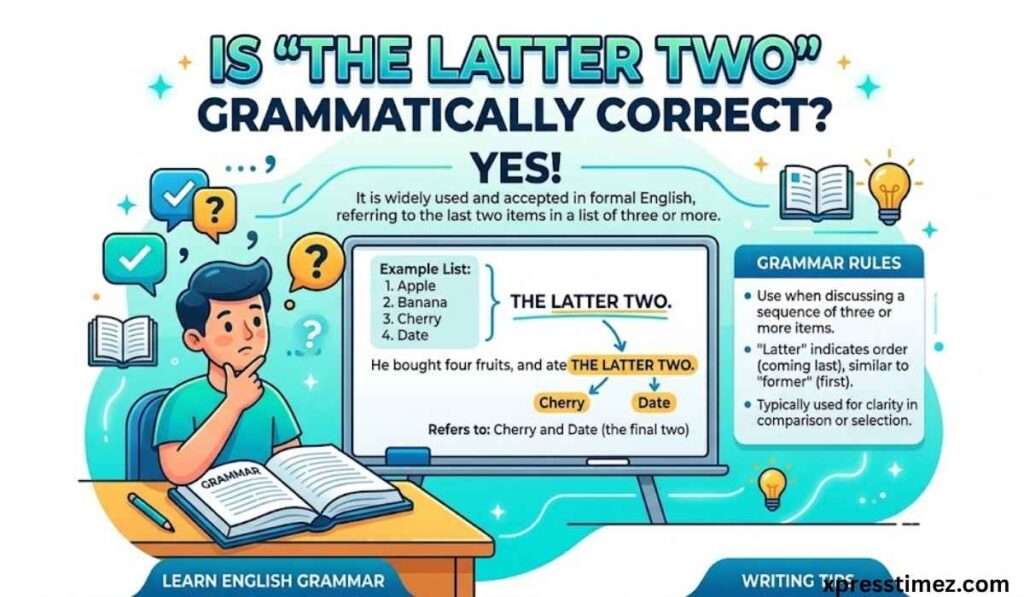
Short answer: often yes, but it depends. Strict traditional rules tie “latter” to two items only. Many modern writers use it more loosely.
So it isn’t a hard error when you weigh The Latter Two vs The Last Two in context. It’s a grammatical correctness gray area, and clarity decides the winner.
When “The Latter Two” Works
It works with a short list that you named just before. The contrast should be obvious. The reader shouldn’t need to hunt for the clear antecedent.
It also fits formal writing that already uses “former” and “latter.” In that setting, it sounds consistent.
When “The Latter Two” Sounds Unclear
It falls apart with long lists. By item five, readers lose track. An ambiguous reference like this makes them scroll back.
It also stumbles when the items sit far from the phrase. Distance kills reader understanding.
Can “The Latter Two” Be Used With Three Items?
Yes, and that’s its best use. With three or more items, it points to the final two cleanly, as long as the list is short.
Style guides differ, though. A few prefer “the last two” for anything beyond a pair. Check your guide if you write for a publisher.
How to Use “The Latter Two” in a Sentence
Good use takes a little setup. Name your items first. Then point back to them quickly.
Three patterns work well. Let’s walk through them.
Short Three-Item Lists
“I considered Paris, Rome, and Madrid. The latter two have warmer winters.” Three items, one clear split.
Keep it this tight. Once you pass three, switch to direct names.
When the Pair Forms a Natural Group
Sometimes the final pair belongs together. Example: “Apples, kale, and spinach are healthy. The latter two are leafy greens.”
The latter group shares a trait, so the phrase earns its place.
When the Reference Appears Nearby
Place the phrase in the very next sentence. A nearby reference keeps things easy to follow.
If a paragraph comes between, rename the items. Your reader will thank you.
How Do You Pronounce Latter and Last?
In American English, “latter” sounds like “LAD-er.” The “t” in the middle sounds soft, close to a quick “d.” The first vowel sounds like the “a” in “cat.”
“Last” sounds like “LAST,” with the same short “a” in American English. It rhymes with “past” and “fast.”
Do not confuse “latter” with “ladder.” They sound almost the same in casual US speech. But they are different words with different spellings and meanings. A ladder helps you climb. The latter helps you point.
“Later” is different again. It sounds like “LAY-ter,” with a long “a.”
How Do You Use Each Phrase in a Sentence?
Let’s look at real contexts. These sentences show how native speakers write.
Everyday conversation:
- “I watched five episodes last night. The last two were the best.”
- “We packed shirts, shorts, hats, and shoes. The latter two took up the most space.”
Workplace and email:
- “Please review the last two paragraphs before our call.”
- “We have four vendors. The former two are local. The latter two ship from overseas.”
Academic writing:
- “The study tested four methods. The latter two showed stronger results.”
In the academic example, the writer set up four items and split them. That is why “the latter two” fits. In the email example, “the last two paragraphs” is simple and needs no setup.
In the latter two vs the last two choice, workplace writing usually favors “the last two.” It is faster to read.
Common Mistakes With “The Latter Two” and “The Last Two”
Most errors come from the same place: the reader can’t tell which items you mean. Let’s fix the big ones people make with The Latter Two vs The Last Two.
These are the common grammar mistakes to watch.
Using “The Latter Two” After Only Two Items
Wrong: “I bought a hat and a scarf. The latter two were cheap.” There’s no “two” left after a pair.
With a pair, say “the latter,” or use “both.” Problem solved.
Creating an Unclear Reference
If your list has five items, “the latter two” could mean anything. Readers shouldn’t guess.
Fix it by naming the items. That’s direct naming, and it never fails.
Using the Wrong Verb Agreement
“The latter two” is plural. Say “the latter two are,” not “is.” The same rule covers “the last two.”
A plural verb keeps your grammar clean. Singular “the latter” takes a singular verb.
Trying to Sound Too Formal
Some writers use “the latter two” to sound smart. It backfires. Stiff phrasing pushes readers away.
Simple, natural wording sounds confident. Skip the show.
What Are the Best Alternatives to “The Latter Two”?
You’ve got plenty of options. Each fits a slightly different need.
Pick the one that keeps your sentence easy to read.
The Latter
Use it for the second of two items. “I like tea and coffee, but I drink the latter daily.” Clean and traditional.
It’s singular, so it takes a singular verb.
Both
Works when you mean two items you just named. “Both are great.” Short and friendly.
It also avoids any ambiguous reference.
The Final Two
A close cousin of “the last two.” It sounds a bit more formal, but it’s still clear.
Use it for final two items in contests, lists, or schedules.
The Remaining Two
This one fits when you’ve already dealt with other items. “Fix the first bug, then tackle the remaining two.”
It stresses what’s left rather than what’s last.
The Second and Third
Great for first and second style numbering. “The second and third options cost less.”
It’s exact, and nobody will wonder what you meant.
Naming the Items Directly
The safest choice. Just say what you mean. “The laptop and tablet had better battery life.”
Use exact nouns whenever doubt creeps in.
What Are the Related Words and Terms?
A few nearby words help you write with more control. Knowing them makes the latter two vs the last two easier to sort out.
- Former two: the first pair in a divided list. It is the mirror of “latter two.”
- First two: the opening items in any list. It is the mirror of “last two.”
- Final two: a formal synonym for “last two.”
- Second half: a plain replacement for “latter” in many sentences.
- Penultimate: the next to last item. It means only one item, not two.
- Latter part: the later section of something, like “the latter part of the year.”
One more point: “latter” can also mean “recent.” For example, “in the latter years of his life.” That is a different use, and it does not connect to lists.
Is There a Difference in American and British English?

Not a big one. Both varieties use “latter” and “last” with the same meanings. Both prefer “the last two” for everyday writing.
British writers may lean a little more toward formal “former” and “latter” pairs, especially in academic prose. Even so, plain English guides in both countries suggest clearer options when the list is long.
The main difference is pronunciation. In American English, the “t” in “latter” is soft and sounds like a “d.” In British English, the “t” is usually sharper and more clear.
The spelling stays the same everywhere. So the latter two vs the last two question is about meaning, not region.
How Can You Choose the Right Phrase Fast?
Run a three-second check for The Latter Two vs The Last Two. Ask: do I have exactly three items, a clear contrast, and a nearby list? If all three are yes, “the latter two” is fine.
If any answer is no, go with “the last two” or name the items. Context matters, and writing clarity should be your final test.
Quick Answers to Common Questions
Is “The Latter Two” Correct?
Often, yes. It works with a short list and a clear contrast. Strict traditionalists may object, so check your style guide.
What Is the Difference Between “Latter” and “Last”?
“Latter” refers to the second of two things, or a later part of something. “Last” means final in order. The latter vs last gap is contrast versus position.
Can I Use “The Latter Two” With Three Items?
Yes. That’s the best setting. Name the three items first, then point to the final pair.
Is “The Last Two” More Natural?
Yes. It’s how people talk. It also needs less setup, so it’s harder to get wrong.
What Is the Best Alternative to “The Latter Two”?
Naming the items directly. If that feels long, “the last two” or “both” is a solid backup.
Can “Latter” Refer to More Than Two Things?
Sometimes. Phrases like “latter stages” prove it. Just make sure your meaning stays clear.
Conclusion
The latter two shows contrast, and the last two shows position. The first is formal and picky. The second is flexible and friendly.
When clarity is on the line, name your items. When speed matters, say “the last two.” Try both in your next draft. Then share your favorite example of The Latter Two vs The Last Two in the comments.

Wang Fang is an experienced grammar and language writer who enjoys making English easier to understand. With a passion for clear writing and practical language tips, Wang creates helpful content on grammar, vocabulary, word usage, spelling, and everyday English.
