

Many learners mix up a digraph and a diphthong. The words sound alike, and both often show up with two vowel letters. So the confusion makes sense. Here is the quick answer for digraph vs diphthong. A digraph is two letters that make one sound. A diphthong is one vowel sound that glides from one spot to another. One is about spelling. The other is about sound. This guide explains both terms in plain English. You will see clear examples, a simple table, and tips to tell them apart.
Short Answer: What Is the Difference Between a Digraph and a Diphthong?
A digraph is two letters that together make one sound. A diphthong is a single vowel sound that glides from one vowel position to another inside one syllable.
Digraph describes how a word is written. Diphthong describes how a word is spoken.
The word “ship” has the digraph sh. The word “coin” has the diphthong /ɔɪ/, and it is spelled with the digraph oi. So one word can have both. You will see how that works below.
What Is a Digraph?
A digraph is a pair of letters that stand for one sound. You do not say each letter on its own. The two letters work as a team.
Look at the word “chat.” The letters c and h do not make a “k” sound followed by an “h” sound. Together, ch makes one sound at the start of the word. That pair is a digraph.
Here are more examples:
- sh in “shop”
- th in “thin”
- ph in “phone”
- ck in “back”
- ng in “sing”
A digraph can also be two vowels. The ee in “feet” makes one sound. The ai in “rain” makes one sound too. Teachers call these vowel digraphs or vowel teams.
Remember the key point. A digraph is a spelling pattern. It tells you about letters on the page.
What Is a Diphthong?
A diphthong is a vowel sound that changes while you say it. It starts in one place and slides toward another. All of this happens in one beat, or one syllable.
Try this. Say the word “boy” slowly. Notice how your mouth moves. It starts with a rounded “o” sound and ends with an “ee” sound. That slide is the diphthong.
Now say the word “see.” Your mouth stays still. The vowel sound does not glide. That is a pure vowel, not a diphthong.
A diphthong is about sound, not letters. The word “time” has only one vowel letter, the i, plus a silent e. Yet the vowel sound in “time” is a diphthong. So you cannot find a diphthong just by counting letters. You have to listen.
Digraph vs Diphthong at a Glance
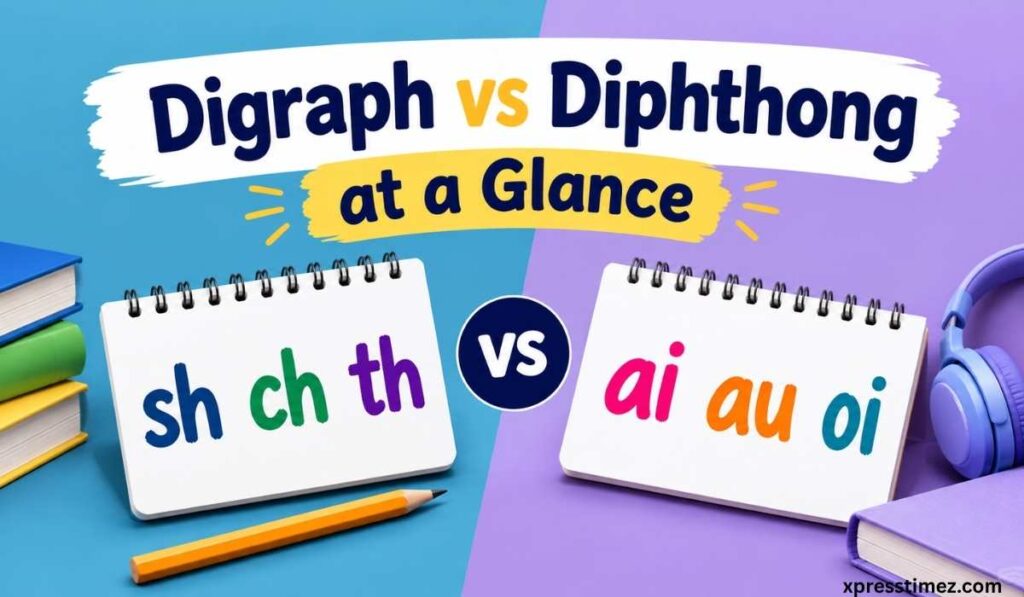
This table shows the main differences side by side.
| Feature | Digraph | Diphthong |
| Type | Spelling pattern | Vowel sound |
| What it describes | Two letters, one sound | One sound that glides |
| Can include consonants? | Yes (sh, ch, th) | No, vowels only |
| Needs two letters? | Yes | No |
| Example | ph in “phone” | /aɪ/ in “my” |
| How you spot it | Look at the word | Listen to the word |
Use the last row as your shortcut. You look for a digraph. You listen for a diphthong.
What Are the Main Types of Digraphs?
There are two big groups. Each group has common patterns you see every day.
Consonant digraphs are two consonant letters that make one sound. The common ones are sh, ch, th, ph, wh, ck, and ng. The pair th can make two sounds. Compare “thin” with “this.” Both are still digraphs.
Vowel digraphs are two vowel letters that make one sound. Here are some common ones:
- ea in “bread” (a short “e” sound)
- ee in “tree” (a long “e” sound)
- ai in “paint” (a long “a” sound)
- oo in “moon” (a long “oo” sound)
- ou in “soup” (an “oo” sound)
Notice that the same letters can make different sounds. The pair ea sounds different in “bread” and “beach.” It is still a digraph in both words. The pair of letters counts, even when the sound changes.
Read Related Post: Chris’s vs Chris’: Which Possessive Is Correct? A Simple Grammar Guide
What Are the Common Diphthongs in American English?
American English has about five diphthongs that most learners study. Here they are, with the sound symbol and an example.
- /aɪ/ as in “my,” “time,” and “high”
- /aʊ/ as in “now” and “house”
- /ɔɪ/ as in “boy” and “coin”
- /eɪ/ as in “day,” “make,” and “rain”
- /oʊ/ as in “go” and “boat”
Notice how many spellings one diphthong can have. The sound /eɪ/ shows up in “day,” “make,” and “rain.” The spelling changes, but the glide stays the same.
Accents vary. Some speakers glide more than others, and some British accents have extra diphthongs. This guide sticks to the most common US sounds.
Can One Word Have Both a Digraph and a Diphthong?
Yes. This is where the digraph vs diphthong question gets tricky.
The word “boy” has the digraph oy. Those two letters work as a team. The word “boy” also has the diphthong /ɔɪ/. The letters are the digraph. The sound is the diphthong.
The word “cow” works the same way. The ow is a digraph. The sound /aʊ/ is a diphthong.
Some words have only one of them:
- “Ship” has a digraph (sh) but no diphthong.
- “Time” has a diphthong (/aɪ/) but no digraph.
- “Feet” has a digraph (ee) but no diphthong. The sound is a pure vowel.
So the two terms overlap, but they are not the same. One lives on the page. The other lives in the air.
Where Do the Words Digraph and Diphthong Come From, and How Do You Say Them?
Both words come from Greek. That helps you remember what each one means.
Digraph comes from the Greek di (two) and graphē (writing). So it means “two writings,” or two letters. That matches its job as a spelling term.
Diphthong comes from the Greek diphthongos. It joins di (two) and phthongos (sound or voice). So it means “two sounds.” That matches its job as a sound term.
Here is how to say them:
- Digraph sounds like “DY-graf.”
- Diphthong sounds like “DIF-thong.” Some speakers say “DIP-thong,” and many dictionaries accept that too.
Both are fine in everyday speech.
How Do Digraphs and Diphthongs Look in Real Life Sentences?
You will meet these terms in classrooms, tutoring, and language apps. Here are some natural examples.
Teacher to parent (email): “Your child is learning digraphs this week. We practice sh, ch, and th.”
This sentence is correct because sh, ch, and th are letter pairs that make one sound each.
ESL class: “Listen to the vowel in ‘now.’ It starts with ‘ah’ and glides to ‘oo.’ That is a diphthong.”
This is correct because the vowel sound moves in one syllable.
Tutor to student: “The word ‘rain’ has a vowel digraph, ai, and the sound is a diphthong.”
This is correct in American English, where the vowel in “rain” glides. The letters are the digraph. The sound is the diphthong.
Spelling app: “Tap the word with the digraph ph.”
“Phone” and “graph” would both be right answers.
Teachers often use a digraph vs diphthong chart to show how the two ideas connect. A chart helps because it puts letters and sounds in separate columns.
What Mistakes Do People Make With Digraphs and Diphthongs?
These mix ups are very common. They are a normal part of learning phonics. Here are the big ones.
Mistake 1
Incorrect: “The word ‘see’ has a diphthong because it has two vowels.”
Correct: “The word ‘see’ has a vowel digraph, ee. The sound is one pure vowel.”
Two vowel letters do not make a diphthong. A diphthong needs a gliding sound.
Mistake 2
Incorrect: “A digraph is a type of vowel sound.”
Correct: “A digraph is a spelling pattern made of two letters.”
Digraphs can be consonants too. Think of sh and ch.
Mistake 3
Incorrect: “The word ‘time’ has no diphthong because it has only one vowel letter.”
Correct: “The word ‘time’ has the diphthong /aɪ/, even with one vowel letter.”
Sounds do not depend on how many letters you see.
Most digraph vs diphthong mistakes come from mixing up letters and sounds. Keep those two ideas apart, and the errors fade.
What Related Terms Should You Know?
Several nearby words show up in phonics lessons. Knowing them makes the main terms easier to hold on to.
- Monophthong: a pure vowel sound with no glide, like the vowel in “see.”
- Trigraph: three letters that make one sound, like igh in “night” or tch in “catch.”
- Blend: two or more letters that keep their own sounds, like bl in “blue.” In a blend, you can hear both letters. In a digraph, you cannot.
- Split digraph: two letters separated by another letter, like a_e in “make.”
- Grapheme: the written symbol for a sound. A digraph is a grapheme made of two letters.
- Phoneme: a single sound in speech. A diphthong is one phoneme.
- Triphthong: a rare glide through three vowel positions, heard in some pronunciations of “fire.”
The grapheme and phoneme pair is the best memory aid. Digraphs belong to graphemes. Diphthongs belong to phonemes.
How Can You Tell a Digraph From a Diphthong Fast?
Use these simple checks.
- Ask what you are studying. If you are studying letters, think digraph. If you are studying sound, think diphthong.
- Do the mouth test. Say the vowel slowly. If your mouth moves, it is a diphthong. If it stays still, it is not.
- Count sounds and letters. Two letters with one sound point to a digraph.
- Check for both. Words like “boy” and “cow” can have a digraph and a diphthong.
Digraph vs diphthong becomes easy when you split the job. Look at the letters first. Then listen to the vowel.
FAQ
Is a digraph the same as a diphthong?
No. A digraph is two letters that make one sound. A diphthong is a gliding vowel sound. One is about spelling, and the other is about speech.
Digraph vs diphthong: which one is about spelling?
The digraph is about spelling. It describes a pair of letters. The diphthong is about sound.
Is “oy” a digraph or a diphthong?
It can be both. The letters oy form a digraph. The sound in “boy” is the diphthong /ɔɪ/.
Is “ee” a diphthong?
No. The letters ee form a vowel digraph. The sound in “feet” is a pure vowel, so it is not a diphthong.
The One Rule to Remember About Digraph vs Diphthong
Letters or sounds. That is the whole idea. A digraph is two letters with one sound, like sh in “ship.” A diphthong is a vowel sound that glides, like the one in “boy.” When you read a word, look for the digraph. When you say a word, listen for the diphthong. Keep that split in mind, and the digraph vs diphthong puzzle will stop feeling hard.

Wang Fang is an experienced grammar and language writer who enjoys making English easier to understand. With a passion for clear writing and practical language tips, Wang creates helpful content on grammar, vocabulary, word usage, spelling, and everyday English.
