

Many people stop and wonder, “Is it I run or I ran?” The confusion is common because “run” works as a present form and as a past participle. Here is the quick answer for run vs ran: use run for now and ran for a finished past action. Say “I run every day” and “I ran yesterday.” The verb has an odd pattern, so even strong writers pause. This guide makes it simple. You will see meanings, tenses, examples, mistakes, and easy memory tricks.
What Is the Short Answer to Run vs Ran?
Use “run” for the present and “ran” for the simple past. That is the main rule.
- Present: “I run every morning.”
- Past: “I ran this morning.”
There is one more rule. After helper words like have, has, and had, use “run.” Say “I have run three miles.” Do not say “I have ran three miles.”
What Do Run and Ran Mean?
“Run” is a verb. Its most common meaning is to move fast on foot. It has many other meanings too. People run a business, run a test, or run a bath. A river runs to the sea. A machine runs well or poorly.
“Ran” is the past tense of “run.” It tells about something that happened and is now finished. “She ran to the bus stop.” “He ran the meeting last week.”
So the two words carry the same meaning. Only the time changes.
“Run” can also be a noun. “I went for a run before breakfast.” In that sentence, the word names an activity. It is not a verb.
What Is the Difference Between Run and Ran?

The difference in run vs ran is time. That is all.
“Run” shows the present. It also shows habits and facts. “Birds run from loud noises.” It works after “will,” “can,” “should,” and “to.” “She will run tomorrow.” “I want to run a marathon.”
“Ran” shows one finished action in the past. “The dog ran across the yard.” Nothing else is needed. No helper word comes before it.
Think of it this way. “Ran” stands alone. “Run” can stand alone for the present, or it can follow a helper word.
Run vs Ran Comparison Table
This table shows the correct and incorrect uses side by side.
| Term | Correct? | Meaning | Use |
| I run | Yes | Present action or habit | I run at the park after work. |
| I ran | Yes | Finished past action | I ran at the park yesterday. |
| I have run | Yes | Past participle with “have” | I have run there twice this week. |
| I have ran | No | Wrong form after “have” | Use “have run” instead. |
| I run yesterday | No | Present form for a past time | Use “I ran yesterday.” |
Look at the last two rows. They show the two mistakes people make most often.
Why Is Run an Irregular Verb?
Most English verbs are regular. They add ed to show the past. “Walk” becomes “walked.” “Jump” becomes “jumped.”
“Run” does not follow that rule. It changes the vowel inside the word. This is the mark of an irregular verb.
Other verbs do the same thing:
- begin, began, begun
- swim, swam, swum
- sing, sang, sung
- drink, drank, drunk
“Run” has a twist. Its past participle looks just like its base form. The three forms are run, ran, run. Verbs like “come” (come, came, come) and “become” (become, became, become) work the same way.
That repeat is why people mix things up. The first and third forms match, so the middle one feels like the odd one out.
What Are All the Forms of Run?
Every English verb has a few forms. Here are the forms of “run.”
- Base form: run (“I run.”)
- Third person singular: runs (“She runs fast.”)
- Present participle: running (“They are running late.”)
- Simple past: ran (“We ran home.”)
- Past participle: run (“He has run that route before.”)
Notice the spelling of “running.” The final “n” doubles before ing. The same happens in “runner.”
Compound verbs follow the same pattern. “Outrun” becomes “outran.” “Rerun” becomes “reran.” “Overrun” becomes “overran.” The past participle of each one matches its base form.
Where Do Run and Ran Come From?
The verb “run” is very old. It goes back to Old English, where related forms meant to flow or to move fast. That is why we still say a river “runs.”
The habit of changing a vowel to show the past is also old. English inherited it from its Germanic roots. Many of our oldest and most common verbs still work this way.
Over many centuries, spelling and sound changed. The vowel pattern stayed. That is why “ran” survives today, even though most new verbs just add ed.
How Do You Pronounce Run and Ran?
The two words differ by one vowel sound.
“Run” sounds like sun and fun. Your mouth stays relaxed. The sound is short and flat.
“Ran” sounds like fan and can. Your mouth opens wider. The vowel is longer.
Say them out loud: “Run, ran, run.” You can feel the change in your jaw. This is the same in American and British English, so there is no regional difference to worry about.
How Do You Use Run and Ran in Sentences?
Real sentences help the rule stick. Here are examples from different settings.
Everyday conversation
- “I run at the park after work.”
- “We ran out of milk this morning.”
Workplace
- “Our team runs a weekly sales report.”
- “She ran the meeting very well.”
- “I have run the numbers twice, and they match.”
- “The program ran into an error, so I restarted it.”
Academic writing
- “The scientists ran the test three times.”
- “The study has run for two years.”
Why is “has run” correct in that last sentence? The helper word “has” needs the past participle. The past participle of “run” is “run.”
Also remember questions. After “did,” use the base form. “Did you run today?” is correct. “Did you ran today?” is not.
What Are the Most Common Run vs Ran Mistakes?
These mistakes are normal. Many native speakers make them. Here is how to fix each one.
Mistake 1: Using “ran” after “have”
Incorrect: I have ran five miles this week.
Correct: I have run five miles this week.
“Have” needs the past participle. The past participle is “run.”
Mistake 2: Using “ran” after “did”
Incorrect: Did he ran to school?
Correct: Did he run to school?
“Did” already shows the past. The main verb stays in its base form.
Mistake 3: Using “run” for a finished past action
Incorrect: Yesterday, I run to the store.
Correct: Yesterday, I ran to the store.
The word “yesterday” signals the past. Use “ran.”
Mistake 4: Using “run” as the past tense in writing
Incorrect: He run down the street.
Correct: He ran down the street.
You may hear the first version in some spoken dialects. In standard writing, use “ran.”
Which Common Phrases Use Run and Ran?
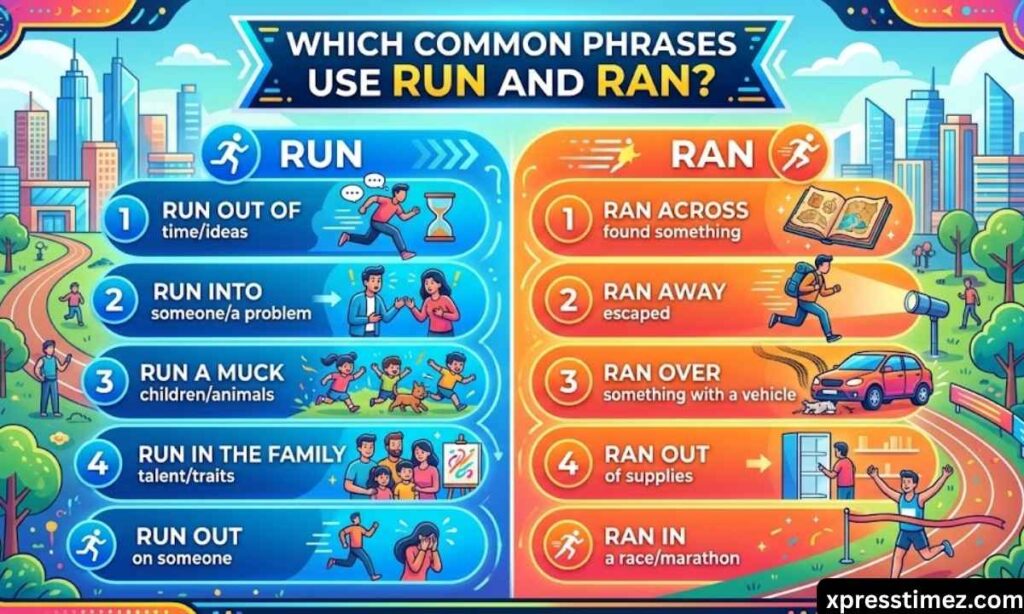
Many everyday phrases use these verbs. Here are some you will see often.
- run out of: “We ran out of time.”
- run into: “I ran into an old friend.”
- run late: “The train ran late.”
- run a fever: “She ran a fever all night.”
- run for office: “He ran for mayor in 2020.”
- run errands: “I ran errands on Saturday.”
- in the long run: “Saving money pays off in the long run.”
- home run: “She hit a home run.”
Some phrases use “run” as a noun, such as “trial run” and “dry run.” A “rerun” is a show that airs again.
Machines use these words too. “The engine ran smoothly.” “The color ran in the wash.” The same simple rule applies to all of them.
How Can You Remember Run vs Ran?
Here are three easy tricks.
The yesterday test. Try adding “yesterday” to your sentence. If it fits, use “ran.” “I ran yesterday” works. If you can add “every day” instead, use “run.”
The helper word test. Look for a helper before the verb. Words like have, has, had, did, will, can, and should all take “run.” No helper? You may need “ran.”
The “ago” trick. “Ran” has an a, just like “ago.” Both words point to the past. “Run” has a u, so think of “you” doing it now.
Another way to see it: “ran” ends the story, while “run” keeps it going.
Run vs Ran FAQs
What is the past tense of run?
The simple past tense of “run” is ran. Example: “She ran to catch the bus.”
Is “I have ran” correct?
No. The correct form is “I have run.” After “have,” “has,” or “had,” you need the past participle, which is “run.”
What is the difference between run and ran in a sentence?
“Run” shows the present, or follows a helper word. “Ran” shows a finished past action. “I run daily” and “I ran yesterday” show the difference clearly.
Is “run” ever used for the past?
Yes, but only as a past participle. “I have run that race before.” For the simple past in standard writing, use “ran.”
Run vs Ran: The One Rule to Remember
Here is the whole lesson in one line: “ran” is for finished past actions, and “run” is for everything else.
Use “run” for habits, for the future, and after helper words like have, did, and will. Use “ran” when the action is over and no helper word is in front. Next time you face run vs ran, ask yourself one thing. Can I add “yesterday”? If yes, write “ran.” If not, write “run.”

Wang Fang is an experienced grammar and language writer who enjoys making English easier to understand. With a passion for clear writing and practical language tips, Wang creates helpful content on grammar, vocabulary, word usage, spelling, and everyday English.
